Sustainable Molecules Ltd. (SuMo) and Velocys (Houston) have successfully commissioned a U.K.-first Fischer–Tropsch (FT) syncrude production system demonstrating that SuMo’s waste-derived syngas can be converted into the liquid hydrocarbon precursors needed to produce sustainable aviation fuel (SAF). The milestone strengthens the technical and commercial case for the UK’s emerging waste-to-SAF industry at a time when demand for credible, scalable SAF solutions has never been greater.
The commissioning marks a significant joint technical achievement for the two partners, validating the production of FT syncrude from syngas as part of the integrated waste-to-SAF pathway. By combining SuMo’s proprietary advanced gasification technology with Velocys’ proven microchannel FT reactor system, this early test phase demonstrates the compatibility and readiness of both technologies to work in sequence — a key milestone towards a full end-to-end waste-to-SAF demonstration.
The FT syncrude demonstration is complementary to the wider ClearSkies project, which is separately funded by a £4.2 million award from the UK Department for Transport’s Advanced Fuels Fund. This early technical validation of the integrated waste-to-SAF pathway is a major step toward a full-scale demonstration. The ClearSkies project brings together technologies from SuMo, Velocys and other globally leading value chain partners with the capability to deliver waste-to-SAF production at SuMo’s Sustainable Molecules Facility (SMF) in Wednesbury — integrating advanced gasification, FT synthesis, fuel upgrading, and carbon capture on a single site, a UK first at this scale.
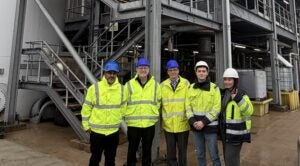
Velocys and SuMo team members at the SMF site in Wednesbury, UK where the microchannel FT reactor system was recently commissioned. (Source: Velocys)
“The commissioning of the FT test rig is a significant step forward — not just for SuMo and Velocys, but for the UK’s waste-to-SAF ambitions,” said Kamal Kalsi, Chief Executive Officer of SuMo. “Bringing together our advanced gasification platform, proven at TRL8, with Velocys’ field-tested FT technology, gives us and our partners real confidence that this pathway can deliver success. The UK generates enormous volumes of residual waste every year. This technology offers a credible route to turning that waste into the sustainable fuels aviation urgently needs.”
“This is a proud moment for both teams,” said Matthew Viergutz, Chief Executive Officer of Velocys. “The test rig commissioning demonstrates what is possible when proven advanced gasification and FT synthesis technologies are brought together with a shared purpose. SuMo’s technical and operational expertise at the SMF site, combined with our microFTL™ technology, has delivered a tangible result that advances the case for distributed, waste-derived SAF production in the UK.”
The SMF site has demonstrated SuMo’s core technology to TRL8, converting residual waste and low-grade biomass-based feedstocks into low-carbon syngas using its proprietary advanced gasification technology. Velocys brings to the project its extensive experience in FT synthesis, including design, scale-up, and deployment of modular reactor systems for sustainable fuels applications. Together, the partners plan to expand the SMF infrastructure to validate the complete production chain through to SAF and other low-carbon molecules.
The modular, distributed nature of the SuMo-Velocys solution means it can be deployed at existing waste handling sites, significantly reducing infrastructure costs compared to centralised production models.
The ClearSkies project supports the UK’s ambition to deliver the circular economy for the energy transition and develop domestic low-carbon gases, fuels and molecules including SAF, advance technology readiness, and position the nation as a leader in circular, low-carbon fuels.