Due to current global conditions, raw-material considerations — volatility in particular — are now being taken into account earlier, and integrated more intimately, into project planning and management strategies
Over the past few years, raw materials have moved from the back office to the boardroom. Supply shocks, logistical bottlenecks, extreme price swings and growing sustainability demands have exposed how vulnerable many chemical companies really are. What used to be treated as a tactical purchasing activity — buying the cheapest ton at acceptable quality — has become a strategic question. Which feedstocks, from which partners, under what risk and sustainability profile, will shape the corporation’s future competitiveness?
The chemical process industries (CPI) are discovering that traditional sourcing models, built around annual tenders, single-minded cost optimization and limited transparency, are no longer fit for purpose. Instead, leading players are reframing raw material strategies around three interdependent dimensions: volatility, value and visibility.
Handled well, these three “V’s” can convert raw materials from a vulnerability into a source of sustainable advantage.
Volatility as a design parameter
For decades, much of the chemical industry operated in a world where volatility was cyclical but relatively predictable. Seasonality, economic cycles and feedstock correlations could be handled with experience and a few spreadsheets. That world is long gone. Now, volatility has evolved from merely an unwelcome surprise to a design parameter that is being considered increasingly earlier in project cycles. What we are dealing with today is a structurally more volatile environment across the full chemical-processing value chain — from energy to metals, as illustrated in Figures 1 and 2. Several forces have made volatility not just more frequent, but more structural, as described in the following sections.
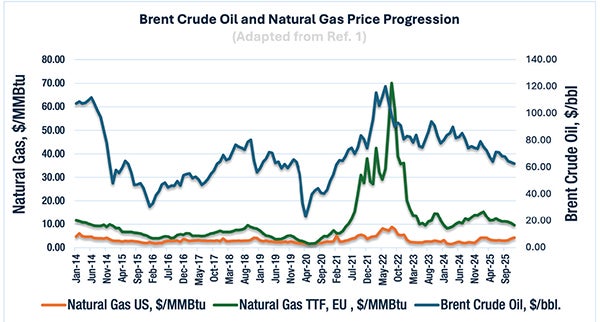
FIGURE 1. Crude oil prices have been subject to increased volatility in recent years [1]
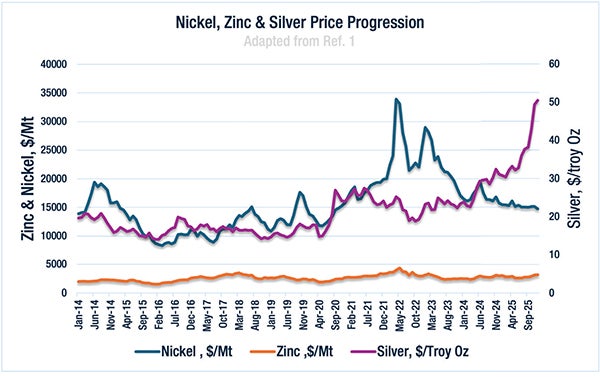
FIGURE 2. Metal markets, similarly to energy markets, are experiencing uncertainty and volatility due to a number of global factors [1]
Energy transition reshaping feedstock economics. Shifts in the global energy mix are changing the economics of steam crackers, refineries and derivative chains. The availability and pricing of key feedstocks and byproducts are no longer anchored in stable fossil supply patterns.
Geopolitical fragmentation and trade tensions. Sanctions, tariffs, export controls and regional industrial policies can switch trade flows almost overnight. A route or supplier that looked optimal on paper can become untenable after a single policy announcement.
Logistics constraints and climate risk. Port congestion, container imbalances, low water levels in inland waterways and climate-related disruptions are increasingly common. Supply routes that were assumed to be stable now carry significant physical risk.
In this context, treating volatility as an exogenous nuisance that procurement teams “manage around” is no longer adequate. Volatility has become a design parameter that must be built into raw material strategy from the outset.
Designing proactively
Moving from reactive to proactive strategies means rethinking several long-standing practices. It is no longer just an evaluation of cost per ton of raw materials; the thinking should now revolve around the total cost of risk.
Over-reliance on single “strategic” suppliers. Historically, many chemical companies pursued scale and price advantages by concentrating volumes with one or two preferred suppliers. This often delivered short-term savings — but at the cost of resilience. A more robust approach distinguishes clearly between materials where single sourcing is acceptable and those where dual or multi-sourcing is non-negotiable due to risk and criticality.
Geographic concentration of supply. The pursuit of low-cost country sources (LCCs) and large integrated complexes has led to geographic clustering. When everything is fine, this strategy works. When an entire region is affected by logistics disruptions, energy shortages or policy changes, it breaks the supply chain. A more resilient portfolio deliberately balances low-cost global sourcing with regional and local options, especially for critical feedstocks.
Static contracts that ignore risk and flexibility. Many contracts are still negotiated almost exclusively around price and volume. In a volatile world, contracts need to become risk-sharing instruments, incorporating the following items:
- Indexed pricing to relevant benchmarks rather than fixed prices divorced from reality
- Volume flexibility bands to accommodate demand swings
- Clauses that recognize and allocate risks related to logistics, force majeure and regulatory changes
Ignoring the optionality embedded in the portfolio. Some companies already have multiple plants, routes or suppliers that could provide flexibility, but they do not treat this as an option to be actively valued and managed. A volatility-aware strategy assesses where flexibility exists (or could be created) and makes conscious decisions about when to pay for it and when to use it.
The bottom line is that volatility is not going away. The companies that win will be those that engineer volatility into their raw-material playbook instead of hoping it will subside.
Looking beyond invoice price
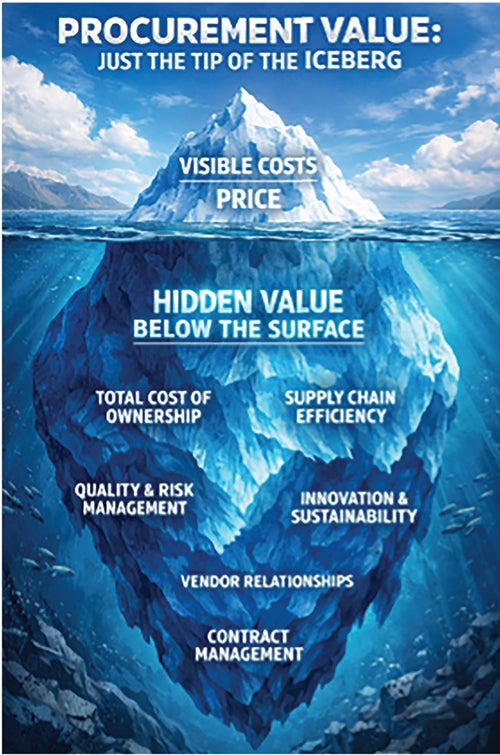
FIGURE 3. Procurement activities involve a complex interplay of numerous considerations, and price is only one aspect of the full picture
When budgets are under pressure, the instinct is to chase unit-cost reductions. Price per ton remains a critical metric, but too narrow a focus on it can be actively destructive to value in today’s environment (Figure 3). Viewed from this broader perspective, the question shifts from “What is the cheapest?” to “What combination of suppliers and materials delivers the highest total value to the business?”
The limitations of a “cheapest ton wins” mentality.Relying on lowest purchase price as the primary decision criterion overlooks a wide range of effects that play out across the balance sheet, including the following:
- An apparently cheap supplier that is unreliable can lead to plant operation stoppages and lost contribution margins many times greater than the nominal savings on the material
- A feedstock with poorer or more variable quality can drag down plant yield, energy efficiency and maintenance costs
- Choosing materials with an unfavorable sustainability profile may result in lost business as customers tighten their Scope 3 emissions requirements, or in future regulatory cost as carbon policies tighten
- Aggressive cost-cutting that damages key supplier relationships can reduce the company’s access to innovation and more collaborative development
Raw-material total cost of risk
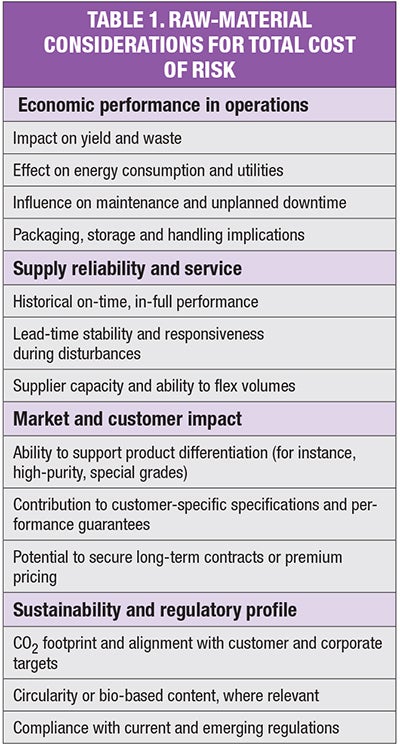 A more comprehensive view of value typically considers at least four dimensions, listed in Table 1.
A fictional but realistic example illustrates the point. Consider a specialty chemical producer that can choose between two monomer suppliers:
- Supplier A offers a very competitive price, but delivers variable lead times, has lower-quality consistency, and cannot provide reliable CO2 data
- Supplier B is marginally more expensive per ton, but offers consistent quality, stable lead times, detailed traceability information and a lower carbon footprint
If procurement focuses narrowly on the price difference, Supplier A will likely win. However, when operations, sales and sustainability are brought into the discussion, the picture changes. A holistic review often shows that Supplier B delivers significantly higher total value, even if the invoice price is higher, due to:
- Higher line utilization and fewer process disruptions with Supplier B
- More compelling customer value propositions due to reliable performance and lower embedded carbon
- Reduced operational and reputational risk linked to traceability and compliance
Embedding value into decisions
Moving toward a “Total cost of risk” mindset does not mean abandoning cost discipline. It actually encompasses a number of considerations, including the following:
- Defining a standard evaluation framework that forces discussion of non-price dimensions for significant materials
- Bringing cross-functional input (operations, quality, sales and sustainability) into sourcing decisions for critical feedstocks
- Updating performance metrics so that procurement is recognized not only for saving money, but for improving reliability, reducing risk and enabling premium business
- Ultimately, value-centric raw-material strategies create more resilient profits and better alignment with long-term strategic goals
Visibility: The new currency

FIGURE 4. Global supply chains consist of many diverse organizations, often operating with differing immediate priorities, so transparency across all tiers is important for project and cost management
Volatility and value considerations are only as good as the information they are built upon. Many chemical companies still lack the visibility they need to manage raw materials effectively end-to-end. The three types of blind spots that are especially problematic are described in the following sections.
Limited upstream insight/Tier “N” mapping. A company may know its direct supplier well but have little understanding of the wider chain (secondary, indirect suppliers often referred to as Tier N) and the feedstocks, intermediate assets or logistics networks that sit behind them (Figure 4). Outages or constraints one or two tiers upstream often come as a surprise.
Fragmented internal data. Dimensions such as demand forecasts, actual consumption, inventory positions, supplier performance and quality data are frequently stored in separate systems or spreadsheets. Aligning them requires manual effort, but the effort pays off in allowing producers to see the full picture or react quickly.
Insufficient sustainability and traceability data. As customers and regulators demand more granular carbon footprints and origin information, many organizations struggle to provide credible, auditable data at the level of product, batch or customer.
In such an environment, decisions are forced to rely on partial information, gut feel and backward-looking reports. This is no longer acceptable when the cost of a misjudgment can be measured in lost business and large swings in profitability.
What good visibility looks like
Leading companies are gradually building more integrated views of their raw-material landscape. This typically includes the following:
- A single, coherent view of demand, supply, inventory and supplier commitments for key materials, accessible to both procurement and supply chain
- Near real-time tracking of inbound shipments and logistics status for strategic feedstocks, especially where disruptions are frequent or costly
- Consolidated supplier performance dashboards that combine delivery reliability, quality-control incidents, responsiveness and sustainability metrics
- Traceability for selected value chains — ideally reaching back to the origin of the raw material and including CO 2 footprint or certification status (for instance, bio-based, recycled or mass-balanced materials)
- The objective is not to collect data for data’s own sake, but to support better decisions, resulting in a number of benefits, listed below:
- Earlier identification of potential shortages or bottlenecks
- More realistic assessment of risks associated with specific suppliers or routes
- Stronger negotiating positions because facts are clear on both sides
- Ability to differentiate among other players in the marketplace using verified sustainability attributes
Utilizing tools as enablers
There is no shortage of digital tools promising “end-to-end visibility,” from supply-chain control towers to supplier collaboration platforms. These can be powerful, but they are only effective when certain requirements are met:
- The underlying data are reliable and relevant (“garbage in, garbage out”)
- Processes and roles are adjusted so that the appropriate people can actually use the information
- The organization clearly communicates about which decisions this visibility should improve
- The goal is to move beyond static spreadsheets and reactive reporting toward “living” information environments that support day-to-day decision-making under uncertainty
Raw-material risk–return profile
Bringing together volatility, value and visibility points toward a different way of thinking: treat raw materials like a portfolio of risk–return profiles rather than a collection of disconnected categories. A practical starting point is to map major raw materials according to the following:
- Supply risk (including concentration, geographic exposure, complexity of logistics and political and climate risk)
- Business criticality (the extent to which the material affects revenue, key product lines or strategic customers)
- Price volatility and sustainability exposure, which can be overlaid as additional lenses
This creates a simple but powerful segmentation that can help to build strategies:
High-risk, high-criticality materials. These may require multi-sourcing, longer-term partnerships, strategic stocks and closer data sharing with suppliers.
High-risk, low-criticality materials. Here, the focus may be on flexibility, alternative suppliers and specifications, and potentially the option to substitute materials or formulations.
Low-risk, high-criticality materials. The emphasis is on performance, quality and collaborative improvements, often supported by stable, long-term arrangements.
Low-risk, low-criticality materials. These can be managed more transactionally, with stronger emphasis on process efficiency and cost.
Framing raw materials in this way reinforces that not all tons are equal. Each cluster demands a different blend of volatility management, value focus and visibility investment.
Strategic conversations
Once materials are clustered, the conversation changes, and the following questions come to the forefront:
- Which materials deserve more strategic attention at senior levels, including risk and investment discussions?
- Where is it worth paying a premium for resilience, sustainability or innovation access?
- Which areas are over-engineered, absorbing scarce management attention without commensurate impact?
This portfolio view also makes it easier to connect procurement decisions to broader corporate strategy, enabling organizations to align high-sustainability materials with flagship “low-carbon” product lines, prioritize resilient sourcing for customers with strict service-level agreements and decide where to build or divest own production capacity versus relying on partners.
From Excel to algorithms
No discussion about modern raw material strategy is complete without touching on digitalization powered by artificial intelligence (AI). Although the topic can easily veer into buzzwords, the underlying shift is real: decisions are increasingly supported by quantitative models and predictive analytics, not only experience.
From static analysis to dynamic scenario thinking. Traditional tools, such as annual market reviews, quarterly price forecasts and static cost breakdowns, struggle to keep pace with today’s volatility.
The point is not to replace human judgment, but to enrich it. When a procurement or supply-chain team can see, within minutes, how a sudden price move affects margins, or what happens if a key supplier becomes unavailable, their response can be faster and more targeted.
More advanced companies are experimenting with “smart” tools, such as:
- Predictive models that link raw material prices to driver variables, such as energy indices, freight rates and macro indicators
- Digital twins and scenario planning tools that simulate the impact of shocks like refinery closures, regulatory changes, extreme weather events or dramatic shifts in trade flows
- Optimization engines that propose feedstock and supplier mixes to minimize cost, while respecting constraints related to carbon, risk or plant capabilities
Implementation with eyes open
Digital tools alone do not solve structural issues. Success depends on starting with priority materials and use cases, not trying to digitize everything at once. This ensures data quality and governance so that people trust the outputs. Also crucial is the training of decision-makers to interpret analytics correctly and to understand the limits of models. Those companies that combine strong domain expertise with intelligent use of data will be better positioned to navigate the ongoing upheavals in raw-material markets.
A practical roadmap
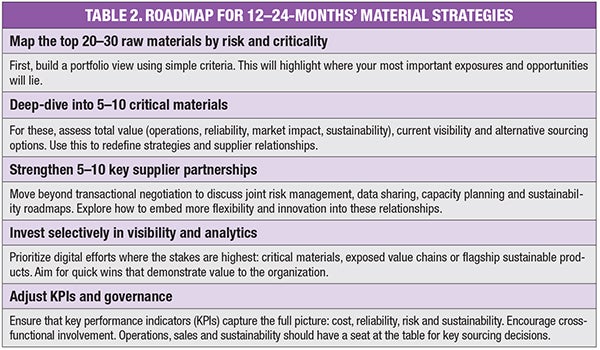
For many organizations, the question is not whether to rethink raw-material strategy, but how to start without overextending resources. A pragmatic example roadmap for the next 12–24 months is shown in Table 2. Taking these steps does not require a multi-year transformation program. It requires clarity on priorities, deliberate cross-functional collaboration and a willingness to view raw materials through a strategic lens.
Turning volatility into advantage
The chemical industry will continue to operate in a world of disruption and transition. Energy systems are decarbonizing, trade patterns are shifting and customers are becoming more demanding and more data-savvy. In such a context, raw materials are no longer just a background cost, they are a central lever of strategic positioning.
Corporations that embrace volatility as a structural function, evaluate suppliers and materials based on total value and invest in meaningful visibility will be far better equipped to adapt. They will suffer fewer surprises, respond faster to disruptions and be better placed to offer differentiated, sustainable solutions to their customers.
Ultimately, the winners will be those who turn volatility into a catalyst for better decisions, not a constant source of crisis. For them, raw materials will cease to be a perennial problem and instead become a powerful source of competitive advantage in a changing chemical landscape. ■
Acknowledgement
All figures provided by author
Reference
1. World Bank Group, World Bank Commodities Price Data (The Pink Sheet), thedocs.worldbank.org, October 2025.
Author
 Siddharth Kalpattu Shivakumar is Director of Global Procurement Market Insights at a global and diversified chemical-manufacturing firm, and a chemical engineer by training. With over a decade of experience across petrochemical, oleochemical and energy-linked feedstocks, he supports global procurement organizations in navigating volatility, managing supplier risk and creating long-term value. He has previously held roles at Axalta Coating Systems and INVISTA and holds a M.S. degree in technology management from the University of Illinois at Urbana-Champaign. He is an active speaker and contributor on intelligence-driven procurement and chemical supply-chain resilience.