Hitachi High-Tech Corp. (Tokyo, Japan) and Powrex Corp. (Itami, Japan) have completed a joint demonstration to investigate optimal coating conditions for the surfaces of cathode active materials used in all-solid-state battery manufacturing — a process designed to prevent output degradation and battery deterioration. The two companies will now accelerate collaborative efforts toward commercialization of the technology.
Coating is a critical factor that directly affects the performance of all-solid-state batteries and requires highly specialized knowledge and experience. The demonstration leveraged Powrex’s (Itami, Japan) technical capabilities in coating, domain knowledge, and extensive equipment operation data, alongside Hitachi High-Tech’s (Tokyo, Japan) physical AI — a platform that combines analytical technology with AI and informatics — to validate an efficient approach to identifying optimal coating conditions.
The collaboration aims to build a system enabling efficient, data-driven process development that has traditionally relied on accumulated specialist knowledge and repeated experimentation. The results will be offered as part of Hitachi High-Tech’s HMAX Industry solutions lineup, targeting a Lab-to-Fab pathway for all-solid-state battery development, reduced time to mass production, and stable supply of high-quality cells.
Lithium-ion batteries used in PCs, smartphones, and electric vehicles (EVs) are widely used as energy sources supporting a sustainable society. In recent years, all-solid-state batteries — which use safer, non-combustible solid electrolyte materials — have attracted growing attention. In addition to improved safety, all-solid-state batteries are expected to offer higher energy density and longer service life, enabling greater EV ranges, fewer recharge cycles, and smaller, lighter battery packs.
One of the key challenges in adopting all-solid-state batteries is developing a manufacturing process that prevents output-degrading reactions. During repeated charge-discharge cycles, a resistive element forms at the interface between the cathode’s active material and the solid electrolyte, causing energy output degradation. To address this, the cathode’s active material is coated with a lithium-conductive oxide film to prevent the formation of this resistive element. Designing an optimal coating process for particulate cathode active materials — accounting for material composition, compatibility with solid electrolytes, and equipment conditions — has historically required significant time, workload, and scarce specialist expertise.
Source: Hitachi High-Tech
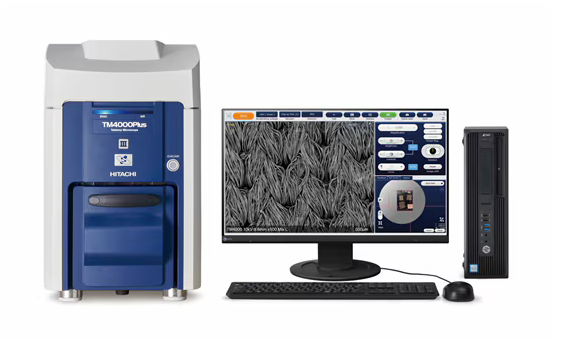
In the demonstration, Hitachi High-Tech’s X-ray fluorescence (XRF) analyzers and scanning electron microscopes (SEM), which require no complicated pre-treatment, were used to analyze samples with fluidized-bed coatings applied under various manufacturing conditions at Powrex. This enabled the evaluation process to be streamlined, reduced measurement variability, and produced a method for quantitatively evaluating coating thickness, uniformity, and interfacial characteristics. Causal relationships between processing conditions, material properties, and battery performance were also clarified.
Based on the demonstration results, Hitachi High-Tech and Powrex will work toward commercializing an optimal coating process proposal as part of the HMAX Industry lineup, in anticipation of the full-scale all-solid-state battery market expected to emerge around 2030. The scope of application will expand to cover various coatings and material types across the battery sector, as well as adjacent industries including high-performance materials, pharmaceuticals, and chemicals.