Rotary dryers are often in operation for many decades after their initial commissioning. This article provides a decision framework to consider whether to upgrade, repair or replace an aging rotary dryer
Rotary dryers are fundamental to ensuring product quality and integrity over a range of broad operating conditions in chemical processing plants. Many of the dryers in operation today were commissioned 30 to 50 years ago and engineered according to process conditions, regulatory standards, production demands and efficiency targets that have since changed.
This aging base of dryers has left many plant managers facing increasing inefficiencies, rising maintenance costs and a growing pressure to mitigate these challenges, either through repairs, upgrades or full replacement (Figure 1). Some plants reflexively choose replacement, reasoning that a 40-year-old dryer is past its useful service life. Others default to ongoing repair simply due to capital constraints or an inability to accommodate the downtime a replacement would require. The best approach, however, should be identified through a structured, problem-driven analysis that accounts for the following:
- The specific technical problems the dryer is experiencing
- The physical and logistical implications of the installation
- Plant long-term strategic outlook
- Cost-shifting factors that can make a seemingly economic option prohibitively expensive
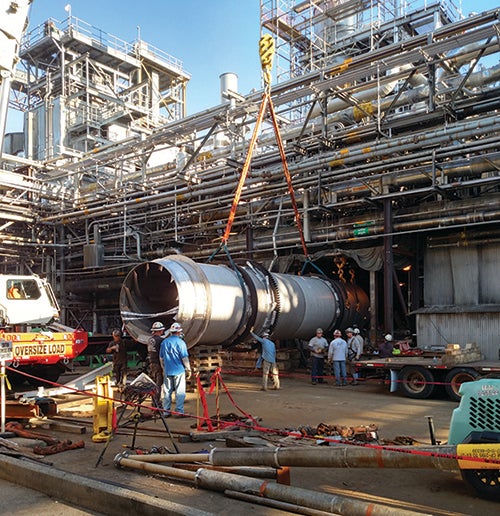
FIGURE 1. The decision to repair, upgrade or completely replace a legacy dryer involves many interrelated factors involving cost, infrastructure, operational performance and more
This article lays out a decision framework that starts with the problem, evaluates each option based on merit and hidden costs and considers site-specific factors that can sway the final decision.
Step 1: Evaluate the problems
The most effective path to resolution depends not on a dryer’s age, but on the problems it exhibits. Thus, the issue should be thoroughly assessed before making any decision. Most older dryers experience one or more of the following issues.
Throughput or capacity limitations.Whether the dryer is unable to meet nameplate capacity, or nameplate capacity is no longer sufficient to meet output requirements, a gap in actual versus required throughput leaves many plant managers considering replacement.
Product quality or consistency issues. Issues with product quality or consistency are particularly challenging, resulting in lost product or the need for reprocessing, both of which strain production schedules and increase operating costs (OPEX).
Rising operating costs. Rising operating costs are one of the most common reasons plant managers begin exploring their options. Whether from escalating fuel costs, frequent downtime or excessive parts and maintenance costs, rising operating costs in any form increase pressure on plant managers to find a resolution as quickly as possible.
Safety and compliance risks. The presence of safety hazards or compliance failures are critical issues that require immediate action to avoid risks to personnel, regulatory fines and reputation damage.
Whatever type of issue the dryer exhibits, the underlying cause of the problem must be identified to make an informed decision that reflects the dryer’s current condition. Is a leaky seal causing a surge in fuel consumption? Are degraded flights preventing product from being dried to specification?
Identifying the root cause of the problem and determining how best to move forward starts with a thorough analysis of the dryer’s condition and its effectiveness in the larger process.
Step 2: Assess the dryer’s condition
Decisions around capital equipment carry substantial ramifications, requiring a systematic approach backed by data, not assumptions. Even when the problem is known, the dryer’s mechanical condition, thermal performance and regulatory compliance influence the decision of whether to repair, upgrade or replace the dryer, necessitating a thorough evaluation.
While aspects of this evaluation can be conducted by in-house personnel, the plant manager will need to bring in the original equipment manufacturer (OEM) or a qualified service provider to conduct the more technically advanced measurements and provide a comprehensive review that encompasses the dryer’s mechanical condition, thermal performance and regulatory compliance.
Mechanical condition
The following sections describe some critical considerations related to a dryer’s mechanical condition.
Shell integrity. The shell is the primary component of the system, and its integrity is the single-most important factor in determining available options. Ultrasonic thickness (UT) testing should be used to map thickness across the drum shell, identifying thin sections and revealing whether wear is localized (repairable) or widespread, requiring partial or full replacement (Figure 2).
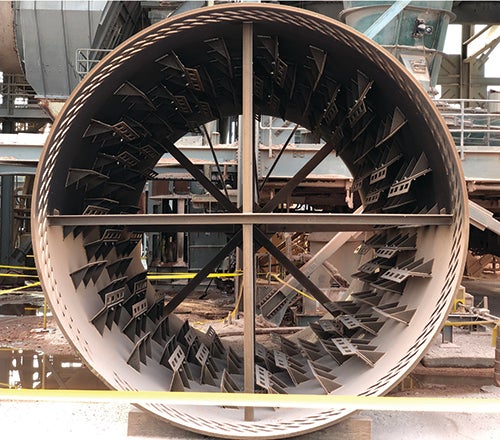
FIGURE 2. A new shell section is shown here, prepared to be a replacement in a legacy unit
Base and drive assembly condition. After the shell, the drum’s supporting structure (foundations, trunnion bases, tires and drive assembly) represents the second-most critical factor in determining available options. These components are costly to replace, both in terms of initial expense and installation cost, because the drum must be lifted off its base in most cases.
Condition of remaining components. Beyond the drum shell, drive assembly and foundations, several additional components contribute to the decision as well. The condition of internals (lifting and advancing flights), inlet and outlet seals and breechings can also influence the scope and cost of each option.
Critical vulnerabilities. The presence of one or more critical vulnerabilities has the potential to rule out repair and upgrade options in all categories of the dryer’s condition. Screening for these vulnerabilities first can help to narrow down options more quickly. Critical mechanical vulnerabilities include a drum-shell thickness below structural minimum across more than 30% of the drum’s length, a shell exhibiting signs of fatigue or shell material that is insufficient for a planned feedstock change.
Thermal performance
While fixing mechanical conditions can resolve some thermal inefficiencies (a leaky seal, corroded flights and so on), several design and process parameters may also be limiting thermal efficiency, strengthening the argument for potential upgrades or replacement. Operators should gather operating data and compare it to design data, looking for gaps in key performance indicators.
Evaporation rate (pounds or kilograms of water per hour). Gaps of 15–30% are common in aging dryers but can often be resolved through upgrades.
Temperature profiles. Deviations of inlet gas, outlet gas and product temperature can point to specific inefficiencies, such as poor gas-to-solid contact or a failing burner.
Residence time. A discrepancy in residence time may be the result of changes in the dryer, such as flight degradation or a misguided adjustment to drum rotational speed.
Fuel consumption. Measuring and trending specific energy consumption (BTU or kJ per pound or kilogram of evaporated water) over time can reveal declining efficiency.
Critical vulnerabilities. As with a dryer’s mechanical condition, the presence of a critical performance vulnerability has the potential to eliminate repair and upgrade options, forcing replacement. A high gap between existing and desired throughput (greater than 40%), where capacity is limited by existing shell diameter and gas flow constraints, for example, typically cannot be solved through upgrades. Because dryer performance is also heavily influenced by upstream conditions, a process audit may be necessary to determine where limitations are originating before making any decisions.
Regulatory compliance
A mechanically sound, thermally efficient dryer means little if the system cannot meet regulatory requirements. The plant should evaluate the following to confirm compliance.
Emissions compliance. Particulate matter, NOx, CO and volatile organic compound (VOC) emissions must be considered against current and future limits, with dryers operating at or near permit limits likely to face forced upgrades regardless of system condition.
Structural and safety codes. Seismic and wind-load requirements have evolved over time, leaving many dryers non-compliant based on current standards.
Burner management system (BMS). Older systems may not meet current National Fire Protection Association (NFPA) 86 standards.
Combustible dust management. Legacy dryers may fail to meet NFPA 660 (formerly 652 and 654) standards for dust hazard analysis, venting and deflagration isolation.
Critical vulnerabilities. If emissions compliance cannot be met with repairs, the plant must invest in significant upgrades or total replacement.
Step 3: Map options to problems
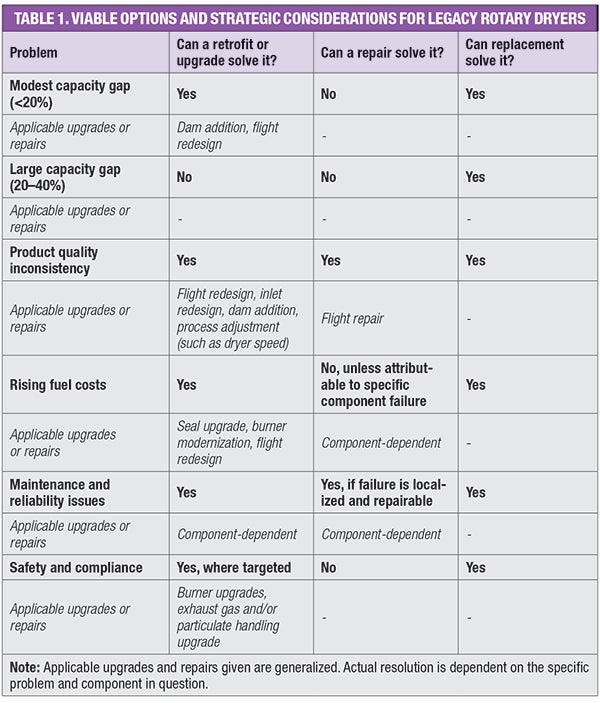
Based on the dryer’s condition, plant managers must weigh the options available against the problem to be solved. In Table 1, where a column shows “Yes,” that option is viable for that problem; where multiple options are viable, cost and strategic considerations become the deciding factors.
Step 4: Consider plant outlook
In evaluating options, plant managers must also anticipate certain considerations that can impact the path of action for a legacy rotary dryer.
Planned capacity expansions. Consider sizing equipment according to known future capacity requirements, which can be more cost-effective in the long term than incremental capacity upgradesor replacements.
Changes to the product line. Determine whether planned changes to the production line or feedstock could potentially impact plant infrastructure needs.
Remaining plant life. Evaluate the plant’s long-term outlook, including market drivers and potential regulatory changes, which may dictate whether repairs, upgrades or replacement make the most economic sense.
Step 5: Look at cost-shifting factors
Plant managers must include costs for the entire project, not just the equipment. The importance of this approach is particularly evident when it comes to site-specific factors that can shift the cost burden from one option to another. Common cost-shifting factors include the following.
Building modification for removal/installation. Many facilities were built around the dryer installation, requiring significant modification of surrounding infrastructure to remove and replace the unit. A “trapped” dryer can easily add $500,000 to $2 million to the replacement cost, creating a strong motivator to make strategic upgrades or repairs instead.
Foundation compatibility. If a new system cannot be made to fit the existing foundations, new infrastructure will be required. New foundations can add anywhere from around $200,000 up to more than $1 million in costs, as well as months of additional downtime, making the case to avoid replacement where possible.
Crane access and mobilization. Remote sites and restrictive plant layouts increase crane costs. If the dryer shell is compromised, crane access costs apply regardless, though costs for a full replacement will almost always be higher.
Controls integration. A replacement dryer’s control system will need to integrate with existing plant technology and could potentially force an upgrade, while a retrofit will usually continue to work with the existing system. Controls can add $100,000 to $300,000 or more in costs, encompassing both the control system hardware and the engineering effort required to develop and validate the controls strategy.
Cost of downtime. The amount of downtime required can vary significantly between options and must be considered. A dryer processing 25 ton/h with a product margin of $30/ton will lose around $126,000 each week that production is down, making a one-month upgrade ($540,000) significantly less costly than a three-month replacement process ($1,512,000) in considering downtime alone.
A comprehensive cost analysis must take all of the above factors into account: capital and installation costs, site-specific costs and the cost of downtime. The decision must also align with the plant’s expected outlook, not just its near-term future.
Step 6: Finalize the decision
When the assessment is complete — problems defined, critical vulnerabilities screened, viable options mapped and full project costs calculated — the decision narrows to a comparative evaluation across remaining options. Three key principles should guide the final decision.
1. Screen for critical vulnerabilities first. A structurally compromised dryer shell cannot be upgraded or repaired at an acceptable long-term risk. Similarly, a dryer that cannot be removed without deconstructing the building may never be replaceable at an acceptable cost. Identify these absolutes from the start, as this can immediately simplify the decision.
2. Cost the full project, not just the equipment. A $1.2-million retrofit and a $3.5-million replacement may seem to be an obvious decision. But once building modifications, foundation work, permitting delays and downtime are accounted for, the gap can be multiples of the initial estimate in either direction, making the decision more complex than it initially appears.
3. Align the decision with the plant’s future. A decision to optimize the plant for the next three years may be economically impractical if the plant is expected to operate for another 20 years. Conversely, a 30-year solution is wasted capital if market conditions point toward a finite remaining life.
No single right answer exists; each plant is unique and plant managers must account not just for what the dryer costs, but for what it costs to remove, what it costs to be without it, and where the plant’s future is headed. ■
Edited by Mary Page Bailey
Acknowledgement
All images provided by author
Author
 Craig Peppin is the customer service manager at FEECO International (Phone: 1-800-373-9347; 3913 Algoma Road; Green Bay, WI 54311; Website: www.feeco.com), where he uses his extensive background in process controls engineering and equipment reliability to assist clients with troubleshooting, maintenance planning and strategic upgrades and repairs. Peppin has a degree in automated manufacturing technology from ITT Technical Institute.