This article made available to you by:

This article provides an overview of the engineering, design and operational considerations associated with reactors and vessels, bridging the gap between theoretical design codes and applied process engineering
Pressure vessels and reactors are critical components in chemical processes. Their design requires careful consideration of mechanical strength, manufacturability, code compliance, operability and economics (Figure 1). This article reviews key technical aspects of vessel design, including vessel service, material selection, head types, pressure codes and practical size limitations.
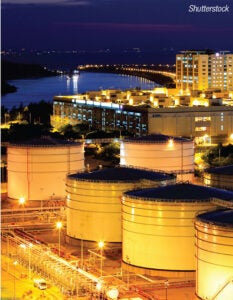
FIGURE 1. Reactor and vessel design is an interplay of mechanical integrity, process needs and practicality. Understanding vessel service, code applicability, material selection and fabrication limitations allows engineers to optimize vessels
API and ASME code designations
Although the terms vessel, reactor and tank are sometimes used interchangeably, they serve distinct purposes and fall under different design and code requirements (see Table 1).
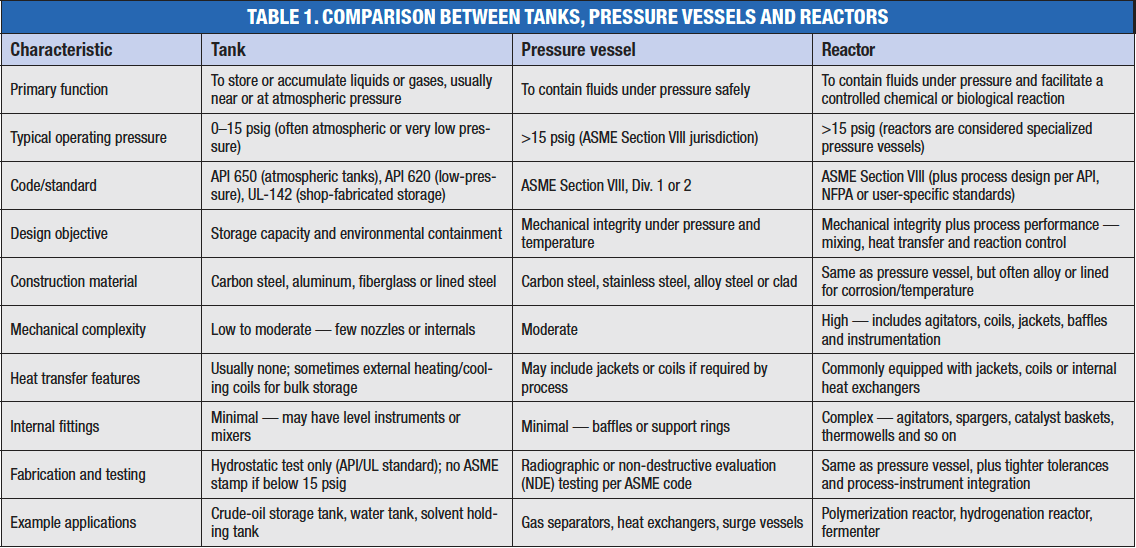
Tanks are typically storage units designed for low-pressure service and large capacity. Fabrication standards focus on weld integrity and environmental containment rather than pipe stress.
Pressure vessels are engineered to withstand internal or external pressure, often at elevated temperatures, with strict design codes and inspection requirements.
Reactors are specialized pressure vessels incorporating process equipment for heat and mass transfer, agitation and reaction control, combining both process design and mechanical design disciplines.
The American Petroleum Institute (API; Washington, D.C.; www.api.org) codes, such as API 620 or API 650, are applicable to storage tanks operating at low pressure or near-atmospheric conditions. American Society of Mechanical Engineers (ASME; New York, N.Y.; www.asme.org) codes govern pressure-retaining equipment with significant internal pressure. In general, ASME focuses on pressure integrity and inspection rigor, while API covers large, low-pressure storage. Pressure vessels are generally designed under ASME Section VIII, Div. 1, which governs construction, inspection and testing for vessels above 15 psig internal pressure. Key exemptions include the following:
- Operating pressure below 15 psig (handled under API 620 or atmospheric tank standards, such as API 650)
- Vessels with internal diameter less than 6 in.
- Vessels with capacity under 120 gal
Key engineering parameters are detailed through the steps of pressure vessel design, including the following:
- Defining vessel service and classifying hazardous or lethal conditions
- Establishing operating and design pressures and temperatures, which govern allowable material stress and required wall thickness
- Selecting appropriate materials of construction and corrosion allowances, including solid alloys, clads and linings
- Determining vessel orientation, length-diameter (L/D) ratios and economic fabrication limits for road transport versus field erection
- Addressing design features, such as openings, jacketing, agitation, overpressure protection and operator access
Define vessel service
Pressure vessels are designed not only for mechanical strength and pressure containment, but also for service classification. This designation reflects the nature of the process, the materials handled and the potential consequences of failure. Properly defining service class early in the design phase determines the applicable design codes, materials of construction, inspection requirements and safety provisions. In some cases, multiple services may be assigned to a vessel (for instance, lethal service with cyclic operation).
Normal service. Normal service refers to standard operating conditions where the process fluid is non-toxic, non-corrosive and operates within moderate pressure and temperature limits. These vessels are typically used for benign liquids or gases, such as water, air, nitrogen or non-hazardous hydrocarbons. The below considerations are for normalservice vessels:
- Standard ASME Section VIII design rules apply
- A typical corrosion allowance is 1/8 in. (3 mm)
- Carbon steel or low-alloy steels are commonly used
- Normal safety factors and testing apply (hydrostatic test at 1.3x design pressure)
Corrosive service. Corrosive service is a classification used for fluids that can chemically attack metal surfaces, such as acids, caustics, brine or chlorinated compounds. This classification emphasizes material selection and corrosion allowance. The following considerations are relevant for corrosive service vessels:
- Guideline references are ASME Sec VIII and NACE
- Corrosion-resistant alloys (such as 316L SS, Alloy 20 or Hastelloy), clad steel or lined vessels (glass, rubber or polytetrafluoroethylene (PTFE)) are common
- Corrosion allowance may be increased to 1/4 in. (6 mm) or more or replaced by corrosion-resistant surfaces
- Regular inspection and wall-thickness monitoring are critical during the life of the vessel
- Dissimilar metal contact and galvanic coupling need to be avoided
Hazardous service. Vessels containing flammable, reactive or otherwise dangerous materials that pose a risk to personnel or the environment in the event of release are considered hazardous service. Examples include hydrocarbon gases, solvents, hydrogen or ammonia. In the case of hazardous vessel service, the following hold true:
- Design often follows ASME Section VIII with supplemental API 510/521 or OSHA requirements
- Enhanced relief and venting design for credible failure scenarios is provided
- Emphasis on leak-tight construction with the use of higher-quality welds and radiography
- Grounding and bonding for static-sensitive systems
- Vessel location may require a detached or diked area
Lethal service. Lethal service, as defined by ASME Section VIII, Division 1, UW-2, is a service in which even a very small release of the contained fluid could cause serious injury or death. Examples include hydrogen cyanide, phosgene, chlorine or anhydrous ammonia under certain conditions. The following considerations are for lethal service vessels:
- All Category A and B weld joints must be 100% radiographed
- Only welded joints are permitted; no screwed or flanged connections in primary containment unless specifically justified
- Use of fully certified materials with full traceability is typical
- Enhanced inspection and documentation are required by an authorized inspector
- Often requires double isolation and venting for maintenance
Cyclic (fatigue) service. Vessels are subject to repeated pressure or temperature fluctuations, which may cause fatigue failure even below the material’s yield stress. This is common in reactors with batch operation, compressors or surge drums. For cyclic service vessels, the following statements hold true:
- Fatigue analysis per ASME Section VIII, Division 2 or Division 3, using S–N curves is done
- Stress concentrators (sharp corners, nozzles, weld mismatches) are minimized
- Forged or integrally reinforced nozzles are preferred
- Monitoring and logging of operating cycles should be done over the vessel lifetime to compare against design life
Thermal or high-temperature service. This service applies to vessels operating above around 650°F (343°C) or below –20°F (–29°C), where material properties, such as yield strength and toughness, vary significantly with temperature. For vessels designated with this service, consider the following:
- For elevated temperature: Creep-resistant alloys (for example, 1¼Cr–½Mo, 2¼Cr–1Mo) or stainless steels
- For cryogenic service: Austenitic stainless steels, aluminum or nickel alloys
- Material allowable stress is temperature-dependent and must be derated per ASME Section II, Part D
- Thermal expansion joints or sliding supports may be required
Vacuum service. Vessels operating at pressures below atmospheric (partial vacuum), such as condensers, vacuum distillation columns or reactor degassers, fall under a vacuum service classification. A code reference for this service is ASME Sec. VIII UG-28. For vacuum service, the following are true:
- Failure mode is buckling, not rupture
- Wall thickness and stiffener rings must be used to prevent collapse
- Often designed for full vacuum (14.7 psia external) even if nominal vacuum is less
- Proper venting during emptying/filling is required to avoid implosion
Sanitary or hygienic service. Sanitary or hygienic service is used in pharmaceutical, food or biotechnology applications where cleanliness, sterilization and contamination control are critical. For sanitary or hygienic service vessels:
- Fabricate to ASME BPE (bioprocessing equipment) standards
- Smooth, polished internal surfaces (≤ 20µicroinches in average surface roughness (Ra)) are typical
- Clean-in-place/steam-in-place (CIP/SIP) capability is common
- Sanitary fittings and orbital welds are used
- All materials must be traceable and FDA/USP compliant
Operating and design conditions
Establishing accurate operating and design conditions for pressure and temperature is one of the most critical steps in vessel design. These parameters directly determine material selection, wall thickness, allowable stress limits, corrosion allowance and code compliance under ASME Section VIII. A well-defined set of operating and design limits ensures safe, economical and code-compliant equipment, minimizing lifecycle risks while maintaining process flexibility.
Operating conditions. Operating pressure and temperature represent the normal or expected process conditions during operation. Operating data should reflect realistic fluctuations, such as startup, shutdown or upset ranges, as these can influence fatigue life and operational safety. Inadequate or overly conservative design conditions can lead to:
- Under-design — Risk of rupture, yielding or failure under upset conditions
- Over-design— Unnecessary material cost, excess weight and fabrication complexity
Design conditions. Design pressure and temperature define the maximum credible conditions the vessel must safely withstand, including possible surges or transients.
- Design pressure — This is set at or above the maximum operating pressure plus an allowance for pressure excursions (typically 10–15%). It dictates minimum required wall thickness and is the basis for hydrostatic test pressure (usually 1.3 × design pressure). Higher pressure increases the required minimum wall thickness, calculated using Section VIII formulas
- Design temperature — This represents the highest expected metal temperature under normal or upset operation. It determines the allowable stress of the material which decreases with increasing temperature. While ductility generally increases at moderate temperatures, elevated temperatures introduce creep, and long-term degradation mechanisms that reduce the material’s load carrying capability and service life. Temperature also affects fatigue and gasket performance. Higher temperatures reduce allowable material stress (per ASME Section II-D)
Material of construction
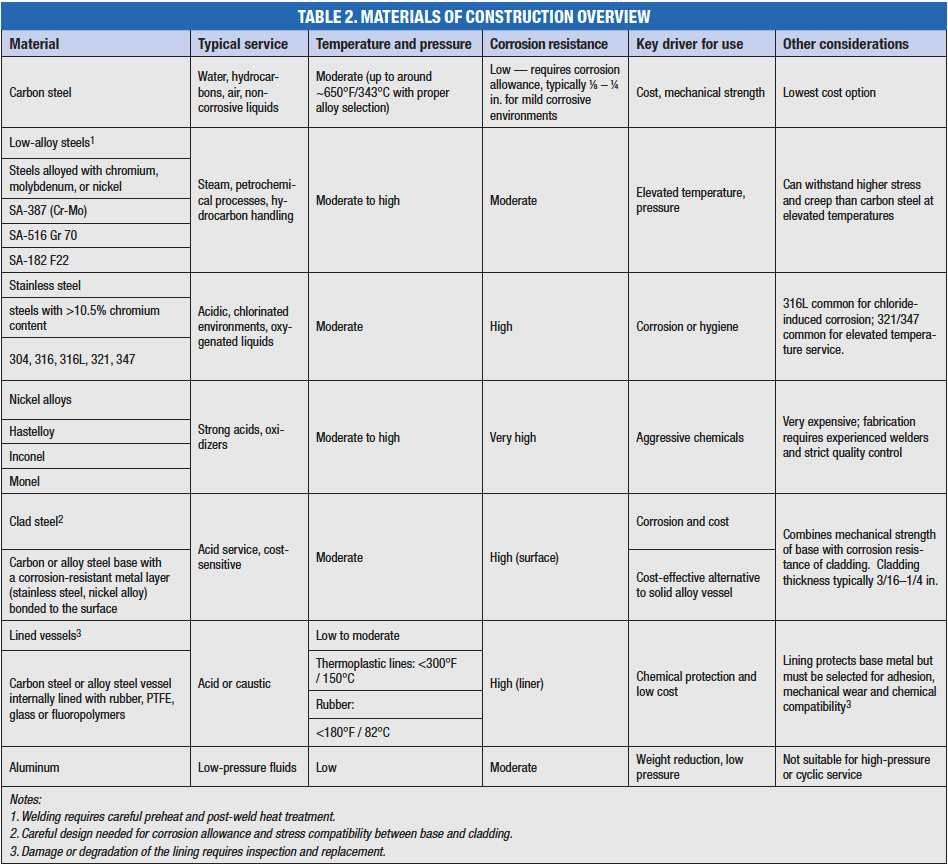
Selecting the appropriate material of construction is a critical aspect of vessel design. Material choice impacts mechanical integrity, corrosion resistance, temperature tolerance, fatigue performance, cost and code compliance (see Table 2). The selection is dictated by a combination of process fluid characteristics, operating pressure and temperature, corrosion potential, regulatory requirements and economic considerations. Factors that dictate material choice include the following:
- Corrosion resistance — fluid acidity or alkalinity, chlorides, oxidizers
- Operating temperature — high temperatures require alloys with good creep and stress-rupture properties
- Operating pressure — high pressure requires steels with high allowable stress
- Sanitary requirements — smooth, non-porous surfaces for pharmaceutical or food applications
- Economic constraints — balance material cost versus longevity and corrosion protection
- Code compliance — ASME, API, BPE or local regulations may dictate material type
- Fabrication feasibility — weldability, availability and size limitations
Dimensions and orientation
Vertical vessels suit limited footprints, reactors or vapor-liquid separation. Horizontal designs are more stable for large volumes. Vessels fabricated in shops must comply with road transport limitations, typically:
- Diameter: up to 12–14 ft (per state or province regulations)
- Length: up to 40–50 ft
- Weight: up to 80,000–100,000 lb gross
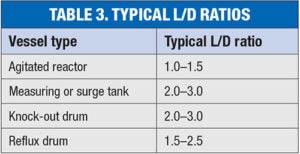
Larger vessels are field-fabricated or shipped in sections for site assembly. Modularization and head removal for transport are common strategies to minimize logistics costs. The L/D ratio is another factor that affects cost and performance (see Table 3).
Openings and nozzles
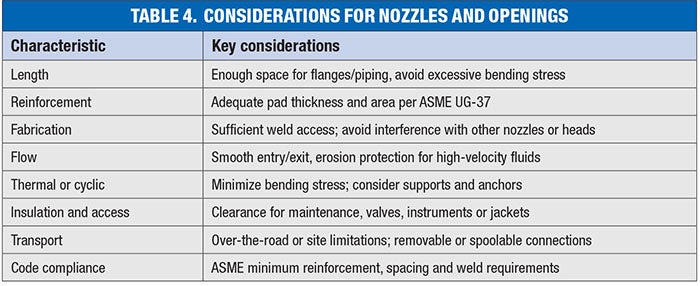
Nozzles are critical interfaces for piping, instrumentation, sampling and maintenance access. Their design and projection from the vessel shell influence structural integrity, manufacturability, pressure containment and process operability (see Table 4). Careful planning ensures the vessel meets ASME code requirements and can be safely fabricated, transported and maintained.
Heating and cooling
Many chemical and industrial processes require precise temperature control to maintain reaction rates, product quality or safety. Reactor vessels often incorporate internal or external heating and cooling systems to achieve these objectives (see Table 5). Large reactors often rely on combined heating and cooling methods to handle startup, shutdown and normal operation conditions.
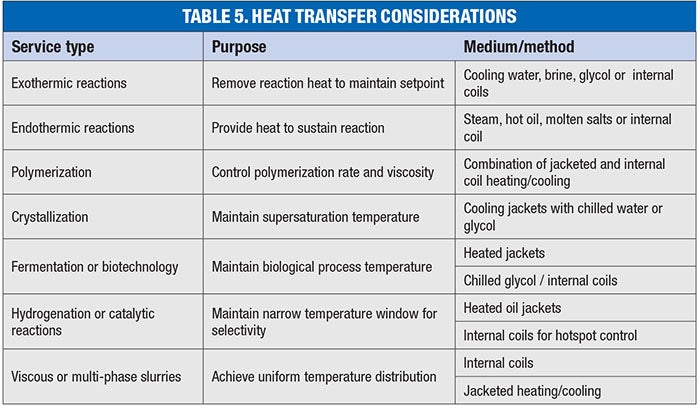
Overdesign of heating and cooling systems can add cost, complexity and maintenance challenges; while underdesign risks hot spots, runaway reactions and poor product quality.
When evaluating options for heating and cooling certain factors need to be considered, including:
- Heat duty — Calculate required heating/cooling power based on reaction enthalpy, vessel volume and desired temperature change
- Temperature control precision — Internal coils allow finer control; jackets handle bulk heating/cooling
- Fluid compatibility — material selection for coils/jackets must resist corrosion, fouling and erosion
- Pressure rating — jackets and coils must withstand internal or external media pressure
- Cleaning and maintenance — internal systems may complicate clean-in-place (CIP) or catalyst handling
- Integration with agitation — agitators improve heat transfer by eliminating stagnant zones, critical for viscous or slurry systems
- Instrumentation — Devices such as temperature sensors, thermowells or resistance temperature detectors (RTDs) should be located strategically to monitor both bulk and local temperatures
External heating or cooling (jacketed vessels). An external jacket is a secondary shell surrounding the vessel, creating an annular space for a heat-transfer medium. Common media include steam, hot oil, water, glycol, molten salts or cooling water. Heating jackets are common for preheating reactants, initiating endothermic reactions or maintaining elevated process temperatures. Cooling jackets are common for removing exothermic reaction heat, quenching reactions or maintaining controlled reaction temperature. Various jacket styles are available, including:
- Conventional or half-pipe jacket — simple, economical, limited heat transfer
- Dimpled or corrugated jacket — higher heat transfer coefficient due to turbulence
- Spiral or external coil— used when uniform surface heating or cooling is desired
Internal heating and cooling (coils, internal jackets or coils in baffles). Internal coils or coil bundles are placed inside the reactor, circulating a heating or cooling fluid directly in contact with a portion of the vessel interior. Internal heating can provide more localized or higher heat flux than external jackets. This is most desired for applications that are highly exothermic or endothermic reactions requiring precise control at specific locations, have viscous or high-solids-content reactions where external jackets alone are insufficient or multi-phase systems (gas-liquid or slurry) to ensure uniform temperature distribution.
Combined internal and external heating or cooling. Combined internal and external heating/cooling is often used focusing external jackets on coarse temperature control and internal coils for fine tuning. This method is common in polymerization reactors, high-viscosity reactions, or multi-step processes. The benefits of this dual control include: greater flexibility in controlling reaction kinetics, improved temperature uniformity in large or high-L/D reactors and reduced risk of hot spots or thermal runaway.
Selecting head type
Head selection often depends on design pressure, allowable height and fabrication cost. For instance, high-pressure hydrogenation reactors frequently use hemispherical heads, while atmospheric condensate drums often use flanged-and-dished (F&D) heads. Common configurations are discussed in the following sections.
Hemispherical head. The strongest and most expensive design, hemispherical heads provide uniform stress distribution and require minimal required wall thickness. They are used for high-pressure applications and reactors where uniform internal geometry is beneficial.
Ellipsoidal head (2:1 ellipse). This is the most common style for pressure vessels. It offers a balance of strength, depth and cost, and requires thinner walls than a torispherical or F&D head at the same pressure.
Torispherical head. The shallowest option, it is easy to fabricate and is often used in moderate-pressure storage tanks and vessels. Higher wall thickness is required than for elliptical or hemispherical heads.
Semi-elliptical and semi-hemispherical head. For this configuration, intermediate geometries are typically chosen for specialized mechanical or process reasons.
Flat head. The simplest configuration, a flat head is constructed of a flat piece of material. It is suitable for low-pressure vessels due to low strength.
Flanged and dished head (ASME F&D). F&D heads include a flat flanged rim and inward dished crown. They are suitable for moderate pressures and are typically thicker than a semi-elliptical head for the same pressure and size.
Generally, F&D heads are the cheapest option, followed by torispherical, ellipsoidal and hemispherical.
Additional design considerations
Overpressure protection. Relief valves, rupture disks or venting should be selected per ASME Section VIII and API 520/521.
Vessel cleaning. CIP or SIP nozzles, removable heads or manways for maintenance should be considered.
Containment and drainage. Engineering should design for spill control and total liquid drain.
Operator access. Ladders, platforms and lighting may be required for safe operation.
Agitation. Reactors and crystallizers often require agitation for mixing, heat transfer and mass transfer. Agitator design influences internal geometry, shaft sealing and motor mounting.
Heat loss from a reactor
Heat loss from a reactor is the rate at which energy is lost from the vessel contents to the surroundings. Correctly estimating this quantity is essential for heater sizing, insulation design, and energy balances. Heat loss can be treated as steady-state (constant temperatures) or transient (temperatures changing with time). The general approach is to identify the dominant heat-transfer modes (conduction through walls or insulation, convection inside or outside and radiation from external surfaces) and combine the thermal resistances. Some practical tips and common pitfalls related to heat loss are listed in the following sections.
Insulation thickness. Small increases in insulation thickness give diminishing returns once the conductive resistance dominates. It is important to evaluate cost versus energy savings (payback).
Bridging losses. Nozzles, manways, support saddles and uninsulated piping create local thermal bridges. Engineers must account for them separately.
Wind and forced convection. Convective heat transfer increases dramatically with wind. Use local standards or wind correlations for outdoor vessels.
Heads and fittings. Heads have extra area; treat their conduction path separately or include as a percentage addition to shell heat loss.
Transient checks. If process upset or cooldown time is important, compute the Biot number and either use lumped system or transient or distributed system solution.
Use conservative assumptions. For safety/instrumentation sizing, use slightly higher heat-loss values (worse-case) and note that real-world variations (rain, sunlight or wind) affect results.
Verification. Measure outer surface temperature or perform an infrared survey on commissioned equipment to validate calculations and adjust insulation or tracing requirements. ■
Edited by Mary Page Bailey
Author
 Kelly Carmina, P.E. (Email: kelly.carmina@rcmt.com) serves as proposal manager at RCM Thermal Kinetics, an engineering and equipment firm specializing in evaporation, distillation and crystallization. With over 25 years of experience in the chemical and industrial sectors, she guides projects from research and development through pilot and commercial scale. Her consulting background, coupled with her experience in heat- and mass-transfer equipment, enables a comprehensive approach that integrates process, mechanical and control considerations with project costing, planning and execution.