NEDO (New Energy and Industrial Technology Development Organization; Kanagawa, Japan), Mitsui Chemicals, Inc. (Tokyo), Maruzen Petrochemical Co., Ltd. (Tokyo), Toyo Engineering Corp. (Chiba City, Japan) and Sojitz Machinery Corp. (Tokyo) have achieved an ammonia co-firing rate of 85% on a heat-input basis across an entire naphtha cracking furnace through operation of a test furnace equipped with a newly developed ammonia-fired burner. This achievement was realized under the Green Innovation Fund Projects by NEDO, “Development of Technology for Producing Raw Materials for Plastics Using CO2 and Other Sources,” under the project entitled “Development of advanced technology for naphtha cracking furnaces by adopting carbon-free heat sources.”
Because ammonia exhibits a lower laminar burning velocity than conventional fuels and generates fuel-derived NOx (nitrogen oxides) emissions, its application to naphtha cracking furnaces requires the simultaneous achievement of stable combustion, appropriate heat transfer to cracking tubes, and suppression of NOx emissions. The achievement of a world-class 85% ammonia co-firing rate while maintaining NOx emissions at levels comparable to those of existing furnaces represents a significant milestone toward the decarbonization of naphtha cracking furnaces.
Moving forward, NEDO and the four participating companies will pursue the realization of 100% ammonia firing across the entire furnace and further promote the practical application of ammonia fuel in the petrochemical industry.
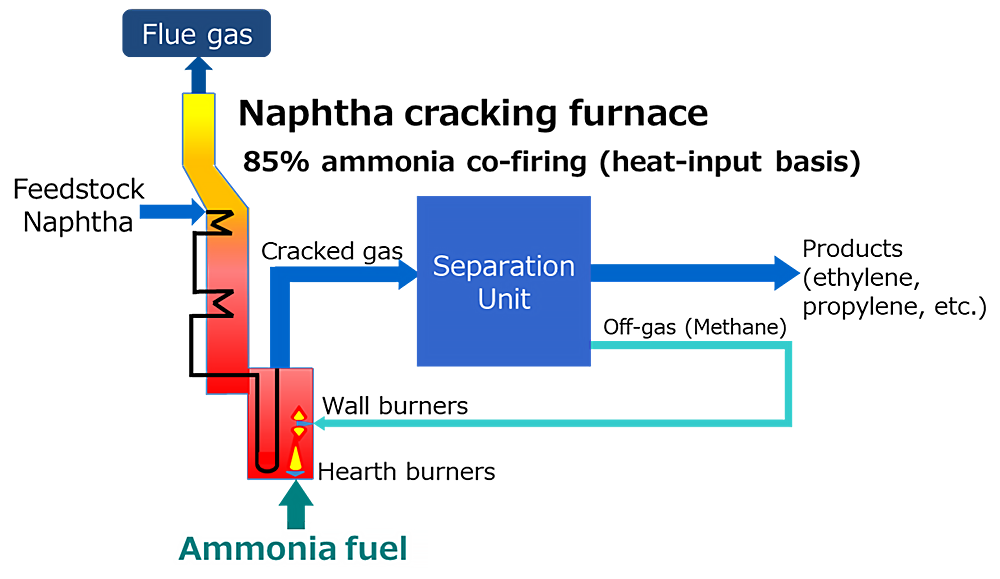
Conceptual Illustration of a Naphtha Cracking Furnace (Source: Mitsui Chemicals)
A naphtha cracking furnace is key equipment used to thermally crack naphtha derived from crude oil at high temperature to produce basic petrochemical products such as ethylene and propylene. While it plays an essential role in supplying feedstocks for plastics, synthetic fibers, and synthetic rubber, it is also one of the major sources of CO2 emissions at petrochemical complexes, making its decarbonization a challenge to address.
Conventionally, naphtha cracking furnaces use off-gas as fuel, primarily composed of methane generated as a by-product. Replacing this fuel with ammonia, which emits no CO2 during combustion, is expected to significantly reduce combustion-related CO2 emissions.
Against this background, Mitsui Chemicals, together with NEDO, Maruzen Petrochemical, Toyo Engineering and Sojitz, has been engaged since fiscal year 2021 in the development of ammonia firing technologies for application to naphtha cracking furnaces under this project. The project aims to develop ammonia-fired burners specifically for naphtha cracking furnaces and ultimately realize 100% ammonia firing across an entire furnace.
Under this project, two types of ammonia-fired burners — hearth burners and wall burners — were developed for application in naphtha cracking furnaces. A hearth burner provides the primary heat input to the furnace, while a wall burner is used to optimize flame shape and furnace temperature distribution.
Compared with methane, ammonia exhibits a lower burning velocity and generates fuel-derived NOx emissions. Its application to naphtha cracking furnaces requires the simultaneous achievement of stable combustion, appropriate heat transfer to cracking tubes, and suppression of NOx emissions.
In this demonstration, the ammonia co-firing rate was increased step by step, and furnace operation was conducted under the following conditions:
- Hearth burners: 100% ammonia firing
- Wall burners: 100% off-gas methane firing (with future application of ammonia planned)
As a result, 85% ammonia co-firing on a heat-input basis across the entire furnace was achieved, representing a world-class level. Furthermore, NOx emissions were confirmed to be comparable to those of existing commercial furnaces.
A distinguishing feature of this achievement is that 100% ammonia firing was realized in the hearth burners, which provide the main heat input to the furnace, resulting in an overall 85% ammonia co-firing rate on a heat-input basis across the entire furnace.
NEDO and the four participating companies will proceed with the application of ammonia to wall burners and aim to achieve 100% ammonia firing throughout the entire furnace.