In late August, technology developer Emvolon, a spinout company from the Massachusetts Institute of Technology (MIT; Cambridge, Mass.; www.mit.edu), signed an offtake agreement with Freepoint Commodities LLC (www.freepoint.com) for methanol produced commercially via Emvolon’s technology starting in spring 2027. The agreement establishes Freepoint as both the anchor off-taker and a cornerstone project capital partner across Emvolon’s global deployment pipeline.
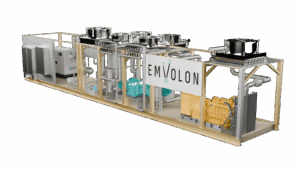
Source: Emvolon
Under a seven-year Commodity Purchase Framework Agreement, Freepoint will serve as the primary buyer for biomethanol and associated liquid fuels produced across Emvolon’s deployment sites. Production volumes are structured to scale toward 300,000 metric tons annually. Freepoint also secured co-investment participation rights. The Emvolon technology is designed to provide waste-asset operators, such as landfills, dairy farms and industrial gas sites with a fully de-risked, turnkey fuel production solution.
The system allows methane producers to monetize methane-rich waste gas that would otherwise be flared or released. Emvolon co-founder and CEO Emmanuel Kasseris says the company gets around prevailing “economies of scale” rules to enable a gas-to-liquids (GTL) process that operates at small scale and low cost, thus allowing economic conversion of waste gases into an easily transportable chemical. To accomplish this, Emvolon has developed a way to retrofit internal combustion engines (ICEs) for converting methane to methanol.
“The ICEs serve as a partial-oxidation reformer, in which fuel-rich combustion of methane produces CO and hydrogen, as well as a compressor,” Kasseris explains. “Then, in a second stage, the synthesis gas (CO and H2) is passed through copper-oxide catalysts to produce methanol.”
The process also includes a pre-treatment step to remove moisture and sulfur compounds.
The small-scale reactor systems can be skid-mounted and the process capacity can be expanded by adding modular units of the skid-based systems. Because the machinery of the units is based on mass-produced truck engines and stationary diesel generators, the capital costs remain low, and the operating costs are reduced by having the unit generate its own power, Kasseris explains.
The units are ideal for oil-and-gas sites, petroleum refining and petrochemical plants, dairy farms, landfills and water treatment plants.
For more information about Emvolon technology, see Chem. Eng., December 1, 2024, p. 9.