
For manufacturers looking to improve the performance and resource efficiency of spray drying operations, the first question does not always need to be: What new equipment do we need? Sometimes, a better question is: What more can we get from what we already have?
Spray dryers are long-life industrial assets, and many plants operating today still have significant potential for improvement. As manufacturers face pressure to increase productivity, reduce energy consumption, maintain product quality and make better use of resources, taking a closer look at existing installations can reveal opportunities that may otherwise remain untapped.
This is where a more circular approach to spray drying can make a difference: extending the useful life of existing equipment, recovering energy that would otherwise be lost, and continuously improving how the process itself performs.
Start with the asset you already have
Improving an existing spray drying operation starts with understanding its current condition and performance. Over years of operation, production requirements can change, components age, new technologies become available and expectations around efficiency evolve. This does not necessarily mean that an entire plant needs to be replaced.
Depending on the installation, repair, reconditioning, refurbishment and targeted upgrades can help extend equipment lifetime and adapt existing assets to current and future production needs. For plants requiring greater output, for example, rebuilding and upgrades can potentially increase capacity without a complete system overhaul. Other modifications can target product losses, powder quality, availability, safety or specific operational constraints.
The principle is straightforward: before replacing an asset, understand whether it’s useful and productive life can be extended.
Look at energy as a resource
The same thinking applies to energy.
Spray drying is an energy-intensive process, which makes the way energy is used, and potentially recovered, an important area for investigation and improvement. Rather than viewing the energy leaving a process simply as waste, manufacturers can assess whether some of it can be captured and reused. Heat recovery systems, for example, can recover waste heat and reuse it to reduce the energy required to heat spray dryer air. Heat pump technologies can create further opportunities to reuse energy within the wider production process and to switch to a more environmentally friendly energy source.
But there is no single solution that fits every plant. The starting point should therefore be an assessment of the existing operation: where is energy being used, where is it being lost, and which improvements make technical and economic sense for that particular installation?
This creates a roadmap for improvement rather than replacing equipment simply because newer technology is available.
Optimize how existing equipment is operated
Circularity is also about making better use of an asset every day.
A spray dryer may be mechanically capable of producing more or consuming less energy, while variability in raw materials, ambient conditions, process parameters and operating practices prevents it from consistently reaching that potential. Optimization therefore represents another important lever for improving existing operations.
The objective is not simply to push equipment harder. It is to find a more stable operating window in which productivity, energy efficiency and product quality can be balanced and then maintain optimum performance as conditions change. Digital process optimization can play a role here, but it is only one part of the wider picture. The real value comes from combining process and equipment knowledge, operating data and continuous improvement to understand where unused potential exists within the plant.
GEA’s process optimization can often be implemented with minimal intervention to existing equipment and little or no production downtime. Deployment is typically completed within a short timeframe, allowing spray dryer operators to start realizing value quickly. In many cases, customers begin to see measurable improvements in productivity, energy performance or process stability within the first month of operation.
From principle to practice: Michigan Milk Producers Association
The experience of Michigan Milk Producers Association (MMPA) illustrates what this can mean in practice.
At its facility in Ovid, Michigan, MMPA operates a GEA COMPACT DRYER for milk powder production. The plant wanted to increase operational efficiency and productivity while also addressing variations caused by different levels of operator experience. Instead of replacing the existing spray drying installation, MMPA focused on getting more consistent performance from the asset already in operation.
GEA OptiPartner® Powder was introduced to continuously optimize the spray drying process. By automatically adjusting process setpoints in real time and combining plant data with process expertise, the system helps keep the dryer operating within an optimized and stable operating window.
For MMPA, the approach resulted in immediate productivity gains, higher moisture load and improved energy efficiency, improvements that have been maintained over time. It also reduced the need for operators to constantly monitor and manually adjust the process, allowing them to focus on other critical activities within the plant.
“After the implementation in 2021, the results were significant both in product rate, and specific energy consumption, but also a huge increase in moisture rate.”
– Gasper Calandrino, Director of Engineering, MMPA
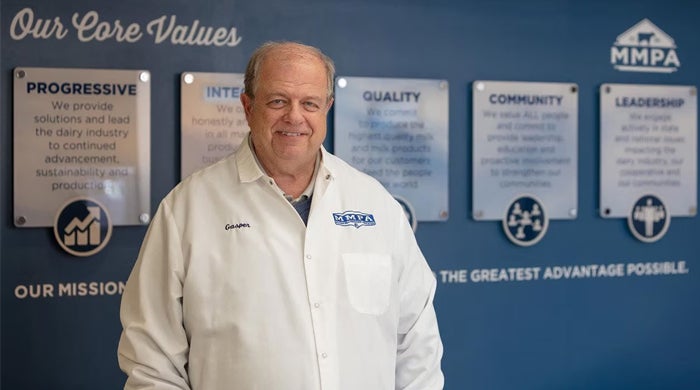
Gasper Calandrino, Director of Engineering, MMPA
Importantly, optimization did not end when the technology was commissioned. Long-term process performance is analyzed together with MMPA, with key performance indicators reviewed to identify further opportunities for improvement. The company is also considering extending the approach to its evaporators following the results achieved with the spray dryer.
The example demonstrates a broader principle: improving the performance of an existing asset is not necessarily a one-time intervention. It can be a continuous process.
Measurable results in chemical powder production
The same principle can be applied beyond dairy. At a chemical powder production plant in Germany, the challenge was to increase performance while maintaining stable production. The plant had been operating conservatively and was also experiencing challenges with deposits during winter conditions.
GEA OptiPartner® Chemical Powder was installed in 2025 to continuously optimize the existing spray drying process and provide greater transparency into production. With OptiPartner active across 92% of production, the plant achieved measurable improvements:
- +5% production rate
- –10% specific energy consumption
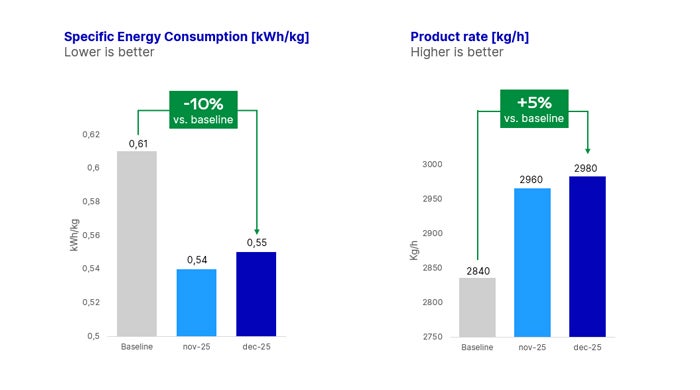
The results show how continuous process optimization can help manufacturers get more from an existing spray drying installation: operating closer to optimal conditions while simultaneously increasing output and reducing the energy required per kilogram of product.
A broader opportunity for spray drying operations
The two examples come from different industries and different operating environments, but they point to the same underlying question: how much more value could an existing installation deliver? The answer will differ from plant to plant, but what connects these approaches is a shift in perspective: from automatically looking for replacement to first understanding the potential of the assets, energy and processes already available.
Discover how GEA Service can help identify opportunities to extend equipment lifetime, recover energy and optimize the performance of existing spray drying operations.
Watch the video: Think Circular. Dry Smarter.