 As federal and state PFAS requirements expand, municipalities, wastewater operators, industrial facilities, airports and fire departments, among others, face a growing challenge: managing PFAS in a way that addresses today’s compliance requirements while preparing for tomorrow’s liabilities.
PFAS regulation in the United States has entered a new era. The U.S. Environmental Protection Agency (EPA) has established drinking water standards for certain PFAS, designated PFOA and PFOS as hazardous substances under CERCLA, and increased reporting requirements for PFAS releases. States are also implementing restrictions and phaseouts affecting PFAS-containing aqueous film-forming foam (AFFF).
For municipalities, industrial facilities, wastewater operations, airports and fire departments alike, compliance increasingly requires looking beyond simply removing PFAS from water or taking legacy AFFF out of service. Organizations must also determine how PFAS-containing wastes will be removed, transported, treated and ultimately documented.
Many conventional PFAS treatment technologies are designed to capture, separate or concentrate PFAS, not destroy it. Granular activated carbon (GAC), for example, can remove PFAS from water but creates a secondary PFAS-containing waste stream that still requires treatment or disposal. Landfilling similarly relocates PFAS rather than eliminating it.
For engineers and environmental managers, that distinction matters. If PFAS is captured but not destroyed, it still exists. It may remain in spent media, concentrates, residual liquids or other wastes that require transportation, storage, treatment or final disposition. For organizations looking beyond immediate compliance toward long-term environmental stewardship and risk management, destruction offers a fundamentally different approach: addressing the PFAS itself rather than continually managing where it goes next.
Destruction can also simplify the overall PFAS management lifecycle. By combining transportation, treatment, analytical verification and documentation with a destruction pathway, organizations may reduce logistical complexity and potentially the lifecycle costs associated with managing persistent PFAS wastes through multiple vendors and disposition steps.
For organizations managing PFAS-contaminated water and liquid residuals or transitioning away from legacy AFFF, Perma-Fix Environmental Services offers a turnkey solution that can include:
- PFAS and AFFF removal and management of contaminated liquid waste streams
- Packaging, coordination and transportation to a Perma-Fix treatment facility
- Permanent PFAS destruction using Perma-FAS™
- Analytical verification of treatment performance
- Documentation and a Certificate of Destruction
- Technical support before, during and after treatment to help customers address waste-management and compliance concerns
Instead of coordinating multiple vendors for removal, transportation, treatment and documentation, customers can work with Perma-Fix and its partners through one integrated pathway, from the initial PFAS waste stream through final destruction.
For fire departments, airports and industrial facilities, Perma-Fix can also support the transition from legacy AFFF, including removal and transportation of existing foam, management of PFAS-containing rinsate, destruction and documentation, as well as coordination of replacement with fluorine-free foam alternatives.
The Technology Behind PFAS Destruction: Perma-FAS™
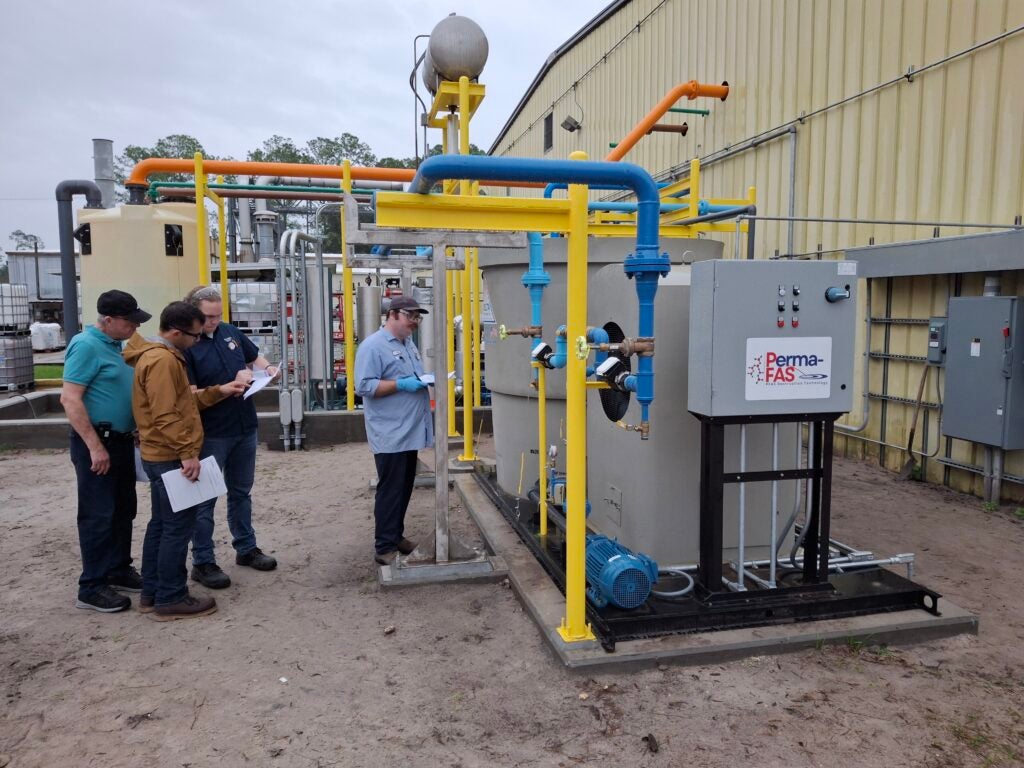
At the center of this turnkey approach is Perma-FAS™, Perma-Fix’s hydrolytic chemical destruction technology. Perma-FAS™ progressively destroys short- and long-chain PFAS and has been demonstrated on low-concentration liquids as well as highly concentrated PFAS products such as AFFF.
Commercial processing is performed in a sealed reactor system at approximately 150°C (300°F) and 75–80 psi, operating at lower temperatures and pressures than alternative destruction technologies described in Perma-Fix’s technical evaluation. The process also incorporates separation and reuse of certain process streams. Reagent-containing solutions can be recycled into subsequent treatment batches until they are depleted beyond economical reuse.
Just as importantly, destruction can be measured and documented. Perma-Fix uses 19F NMR and can supplement that analysis with EPA Method 1633, EPA Method 1621 and total organic fluorine (TOF) testing to provide analytical evidence of treatment performance.
As PFAS requirements evolve, organizations need to think beyond simply getting PFAS out of their water, equipment or storage tanks. Where does it go? Who transports it? How is it treated? Was it actually destroyed? And how do you document what happened to it?
Perma-Fix helps answer those questions through one integrated service. The Perma-Fix team works with customers before, during and after the project to evaluate PFAS waste streams, coordinate removal and transportation, provide destruction, verify treatment performance and supply final documentation. That means fewer handoffs, a more streamlined management process and a pathway focused on destroying PFAS rather than simply moving the problem somewhere else.
Don’t just manage PFAS. Destroy it. Remove it. Transport it. Destroy it. Document it. With Perma-Fix.