 Managing Unreviewed Change Beyond Your PSM Boundary
The Ultimate Management of Change Field Guide for EHS and Process Safety Professionals in Chemical and Industrial Facilities
You have an MOC program, BUT…
If your PSM-compliant program just covers regulated processes, you’ll have safety gaps everywhere else.
Change happens across your entire facility every day, in every department and on every shift. This guide is designed to help you recognize, and take action on change where your current program might be missing it, before something goes wrong. Inside you’ll find resources to help you:
- Identify missed triggers
- Decide if a change needs a review
- Ensure the right people are involved
- Make sure closeout actually happens
Change is Everywhere in Your Facility
These zones represent a source of unreviewed change. What other sources might be at risk?
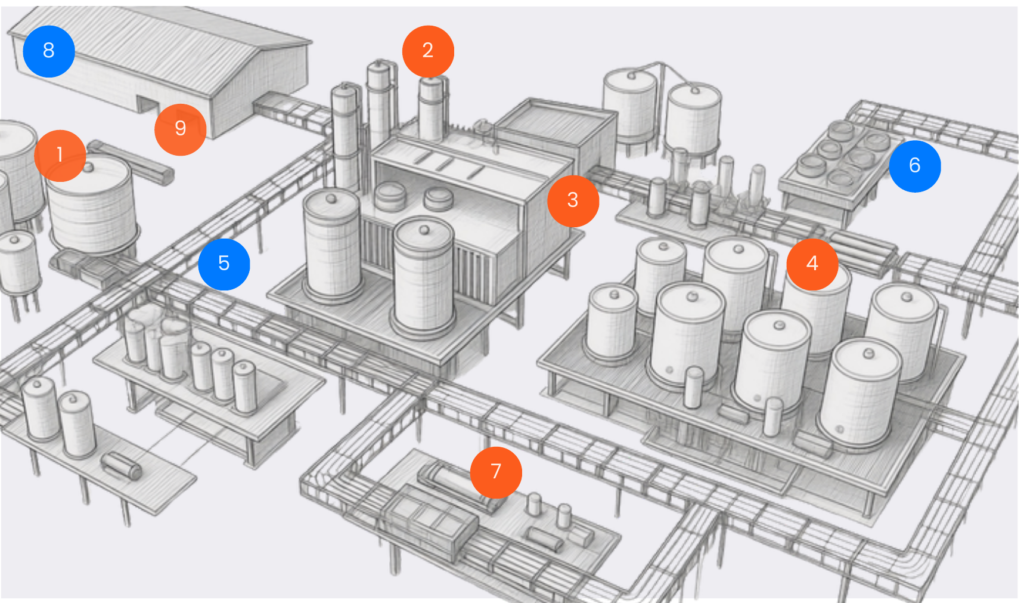

Many process safety incidents involve a change that was missed, underestimated, or poorly controlled.
When the Review Does Not Happen
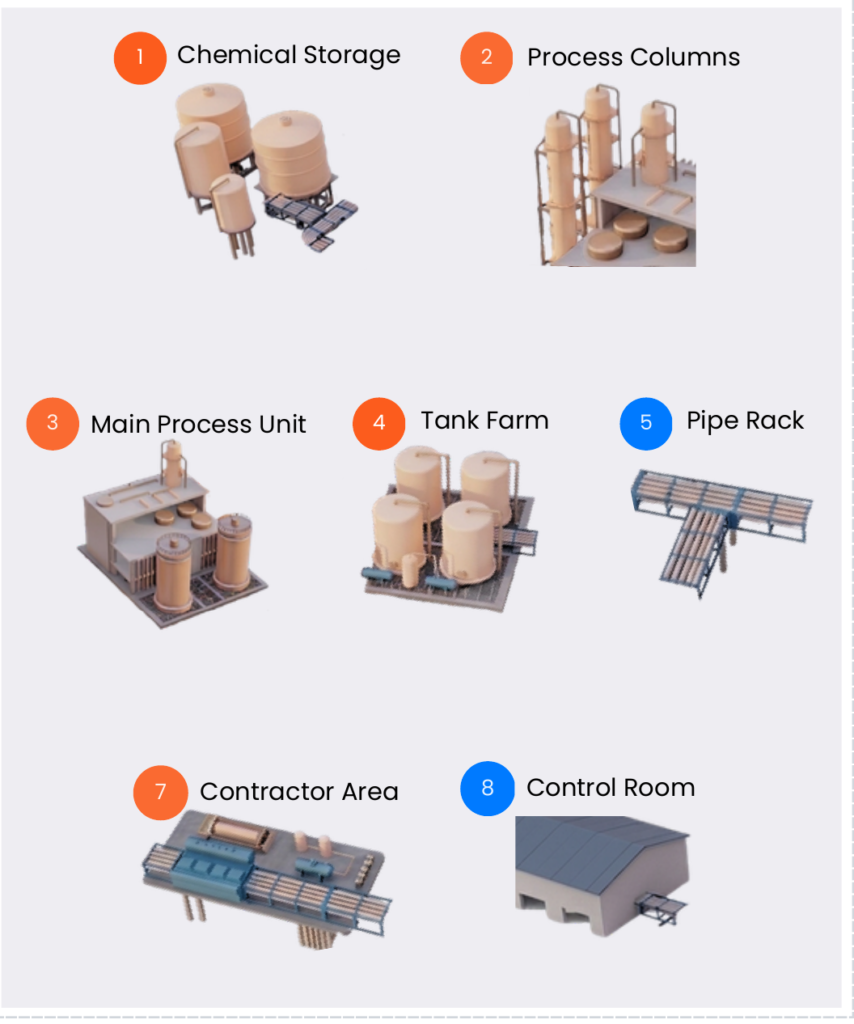
Here is what uncontrolled change looks like when it plays out…
-
- Chemical Change (Chemical Storage):A supplier switch on a raw material seems routine. The new product has a slightly different purity profile. Nobody asks what makes up the remaining percentage. Compatibility, exposure, or process stability concerns are missed.
- New Equipment or Modification (Process Columns):Design assumptions were not revisited during installation. The new unit changes clearances, access, ventilation, drainage, or interaction with an adjacent system in a way no one anticipated.
- Procedure Change (Main Process Unit):An updated SOP gets issued. Training records do not reflect who reviewed it. An operator follows the old version during an upset.
- Startup After Shutdown (Main Process Unit):The lineup is wrong. Action items from the previous shutdown were never verified closed. The startup proceeds anyway.
- Equipment Replacement (Tank Farm):The team orders what looks like the same pump. Different impeller. Different pressure rating. It fails under load. No one can trace why because there is no record of the change.
- Temporary Bypass or Jumper (Pipe Rack):A safeguard is bypassed to solve an immediate problem. No one documents it. The next shift does not know it is there. Three months later it’s still in place, until the day it matters.
- Contractor Work (Contractor Area):An outside crew comes in for hot work near a flammable materials area. The permit is issued, but no one screens whether temporary ventilation, equipment access, or nearby material staging changed the risk. A spark, blocked egress path, or missed isolation point turns routine work into an uncontrolled event.
- Software or Logic Change (Control Room):An interlock or alarm does not respond as expected, and the team has changed a safeguard without realizing it.
-
In each case, what should have triggered a review?
Do I Need an MOC? A Quick Decision Guide
If you’ve ever asked whether something is “really a change”, trust that instinct. When in doubt, evaluate.
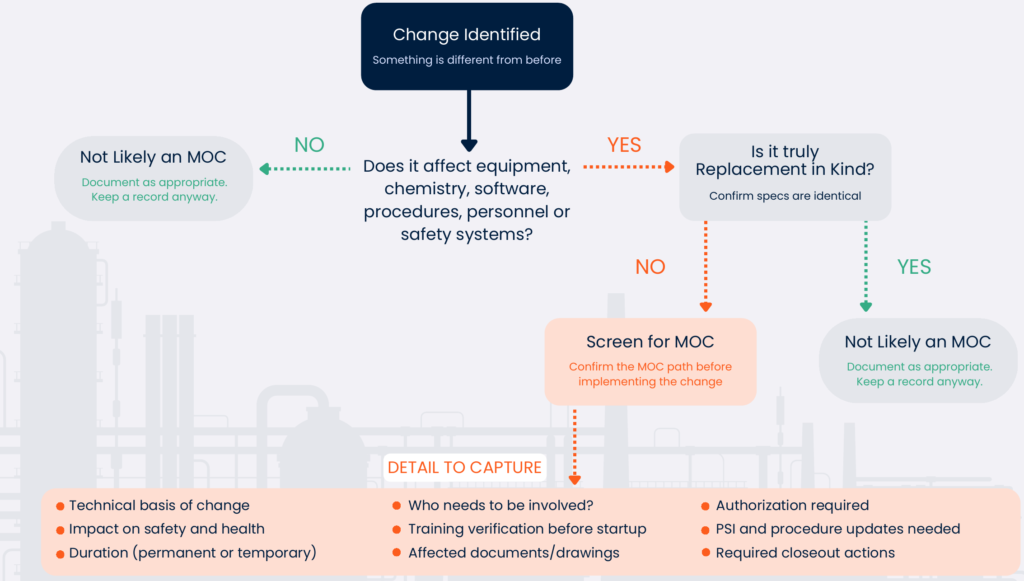
If the MOC is temporary, emergency, or a workaround, you’ll need to capture temporary/emergency status, owner, expiration date, and closeout plan details.
Is It Really a Change?
Commonly Missed MOCs

-
-
- Firmware or software updates, including minor version changes
- Vendor substitutions on chemicals or components
- Alarm or setpoint changes
- Temporary fixes, jumper wires, or bypasses
- Relocating equipment within the facility
- Procedure workarounds that have become standard practice
- New employees starting or changes in job roles
- Simple document changes
-
MOC Screening Strongly Recommended
-
-
- New chemical or supplier, even if the chemical name is the same
- Any equipment replacement where one or more specs differ
- Changes to PLC, DCS, or safety instrumented systems
- Changes to operating procedures or work instructions
- Hot work or contractor activities near covered processes
- Startup after a non-routine shutdown
-
Replacement in Kind? A Tale of Two Pumps
Do you really need an “exact duplicate”? These two pumps might deliver the same results, but they are not the same.
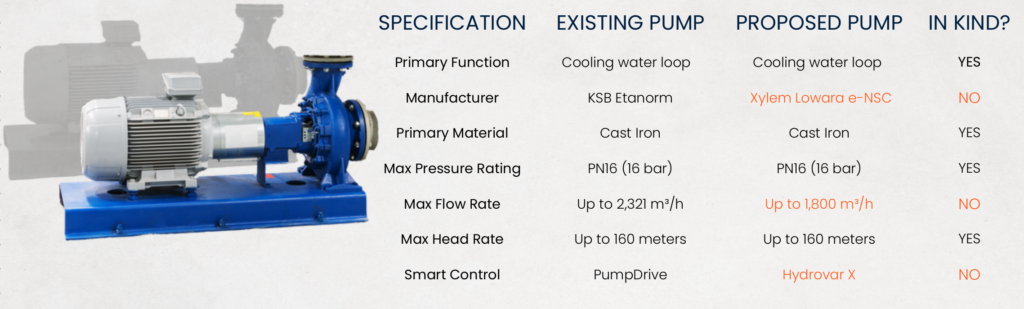
The Standard: Replacement in Kind
The replacement meets the same documented design intent, materials of construction, pressure/temperature ratings, capacity, control function, safety function, and operating envelope.
A Chemical Substitutions Hypothetical
A supplier change that brings in a reagent at 98% purity instead of 99.5%: you may need to confirm impurity profile, concentration, stabilizer, inhibitor, or proprietary components.
If you cannot confirm it is identical, you cannot call it replacement in kind.
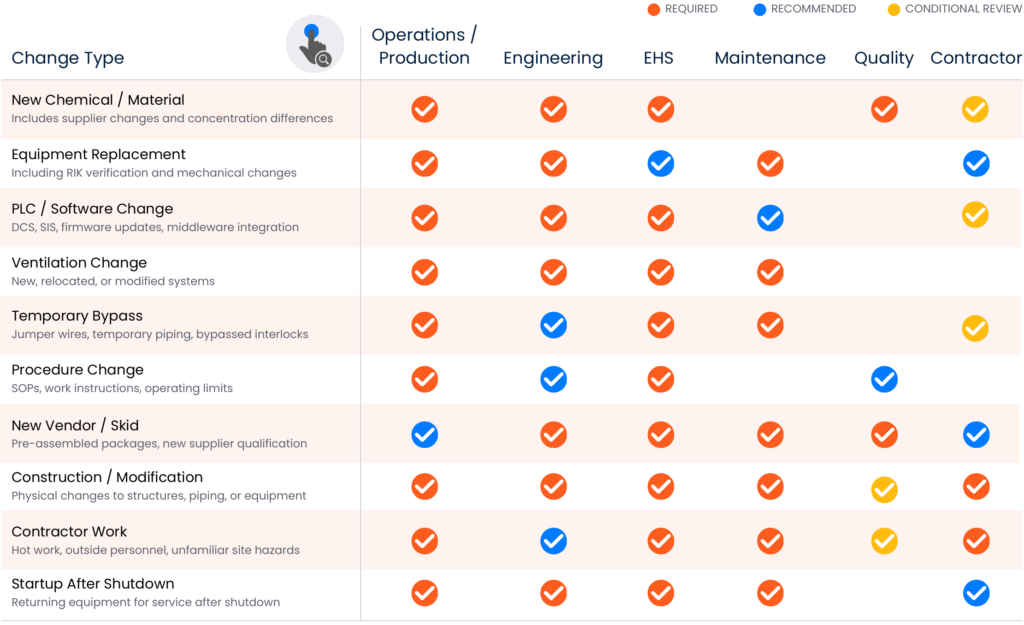
Who Should Be Involved, and When
Use this page when deciding who needs to review the change before approval or startup.
Temporary Changes: Commonly Overlooked
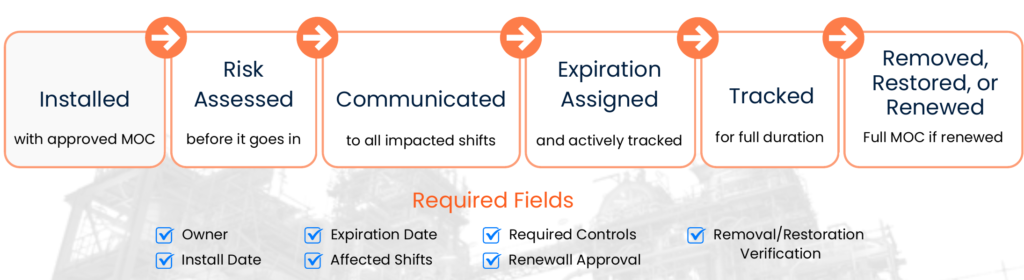
Temporary changes fail when…
-
-
- Nobody owns them. No assigned owner = no accountability
- Expiration dates are ignored. No end date means no urgency to close out
- Shifts are not aware. Incoming crews operate without knowing
- The workaround becomes the norm. Temporary quietly becomes permanent
-
A temporary change nobody tracks is an uncontrolled change.
How it plays out…
A bypass goes in on Monday to solve an immediate problem. No documentation. No expiration date. No owner assigned.
Tuesday’s shift comes in. Nobody mentions it. They assume it was always there.
Six months later it is still in place. It is now just “how things are done.”
No incident yet. But the risk is there every day.
Emergency MOC: Faster But Not Optional
Emergency MOCs exist for when change can’t wait, like when equipment fails. The process is faster where implementation of the change happens before full documentation.
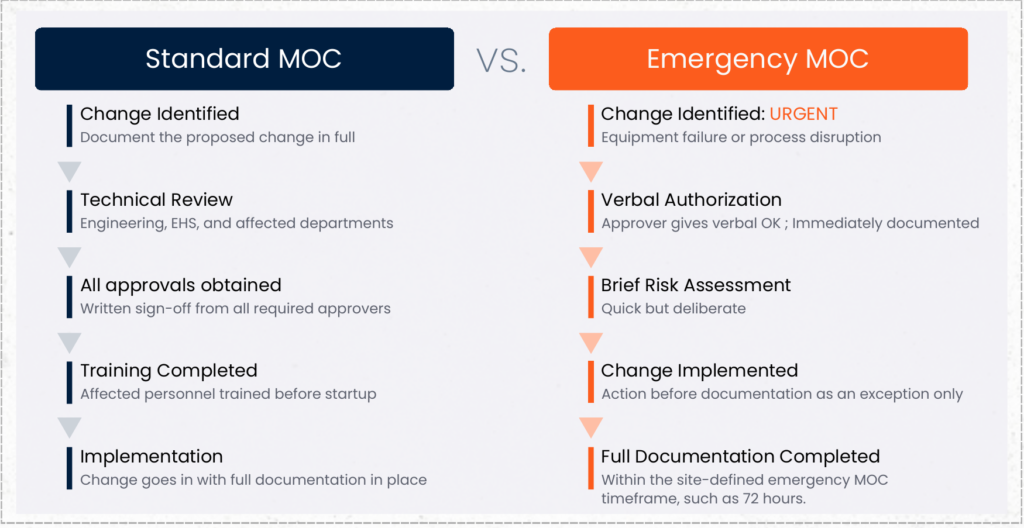
The most common failure: Undocumented Change. The immediate problem gets solved, everyone moves on, and the MOC never gets formally closed. Now there is an undocumented change in your system with no record of what happened or why.
Emergency changes move faster, but they should never get a weaker closeout!
MOC + 13 PSM Elements
OSHA’s Process Safety Management standard outlines 14 elements. MOC is one of them, but change touches nearly all of them.
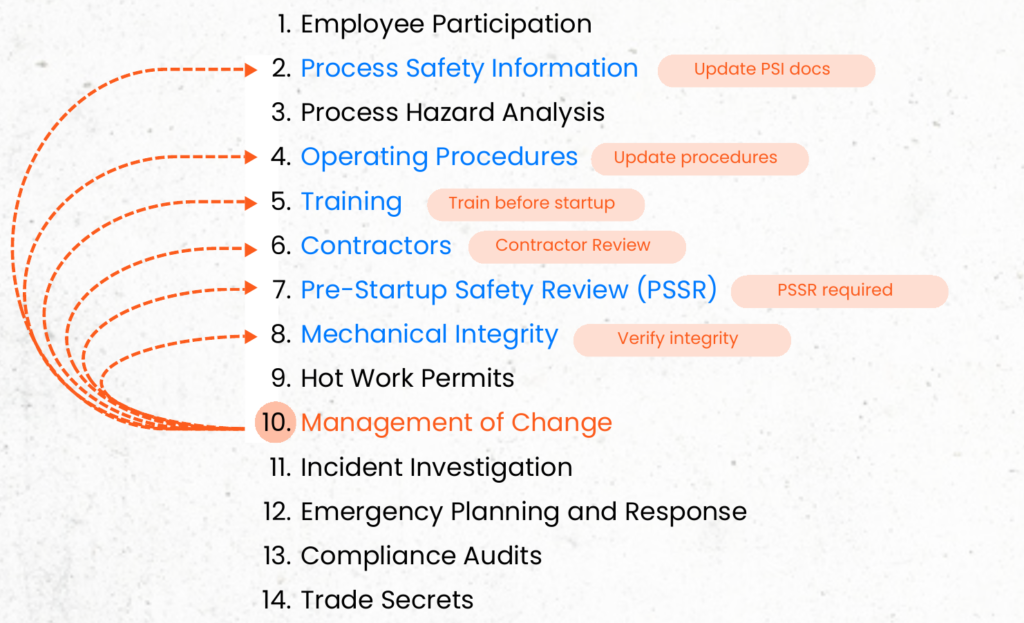
The 14 elements: 1. Employee Participation; 2. Process Safety Information; 3. Process Hazard Analysis; 4. Operating Procedures; 5. Training; 6. Contractors; 7. Pre-Startup Safety Review (PSSR); 8. Mechanical Integrity; 9. Hot Work Permits; 10. Management of Change; 11. Incident Investigation; 12. Emergency Planning and Response; 13. Compliance Audits; 14. Trade Secrets.
What a well-run MOC should automatically trigger
A new piece of equipment may require updated Process Safety Information, revised Operating Procedures, training for affected personnel, and a Pre-Startup Safety Review before it goes live. If contractors are involved, Element 6 applies.
If your MOC process does not surface these downstream requirements, that is a gap worth closing.
MOC is also required under the EPA’s Risk Management Program, not just OSHA PSM. Both agencies maintain General Duty Clause authority that applies even where specific regulatory thresholds are not met. Auditors use it.
Your MOC Program = Institutional Memory
When an experienced operator or engineer leaves, what they knew about your systems doesn’t leave with them if you have MOC records. A searchable MOC record helps new engineers, operators, and site leaders understand the basis for past decisions without rebuilding history from scratch.
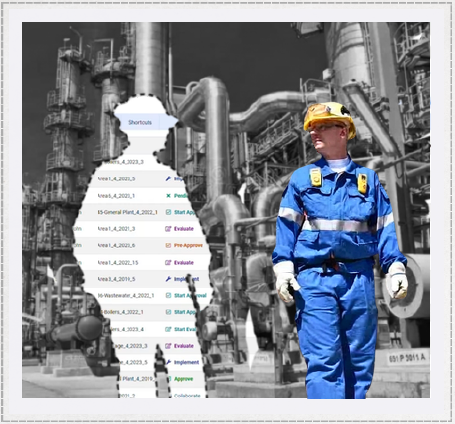
Avoiding the “when did this change and why?” question
A well-run MOC program delivers value that has nothing to do with compliance. It preserves:
-
-
- Why a change was made, not just that it was made
- Who reviewed it and what concerns were raised
- Supporting documentation (ex. cut sheets, SOPs)
- Who was trained, and when
- What action items were opened then closed
- What the pre-startup safety review confirmed
-
A documented MOC from one site is a starting point for another. Most of the work is already done. Without the record, every site starts from scratch.
Are You Audit Ready?
If an OSHA or EPA auditor walked in tomorrow and asked to see your MOC records, what would they find?
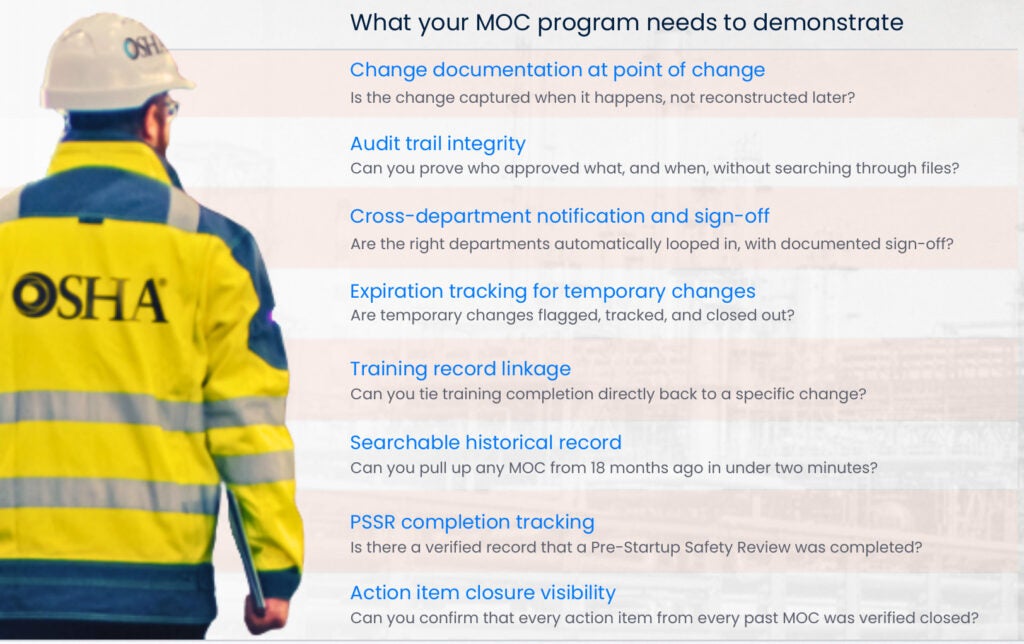
What your MOC program needs to demonstrate
-
-
- Change documentation at point of change: Is the change captured when it happens, not reconstructed later?
- Audit trail integrity: Can you prove who approved what, and when, without searching through files?
- Cross-department notification and sign-off: Are the right departments automatically looped in, with documented sign-off?
- Expiration tracking for temporary changes: Are temporary changes flagged, tracked, and closed out?
- Training record linkage: Can you tie training completion directly back to a specific change?
- Searchable historical record: Can you pull up any MOC from 18 months ago in under two minutes?
- PSSR completion tracking: Is there a verified record that a Pre-Startup Safety Review was completed?
- Action item closure visibility: Can you confirm that every action item from every past MOC was verified closed?
-
The paper and spreadsheet problem
With a manual system, no mechanism exists to prevent an incomplete MOC from advancing. Version control is inconsistent. Records get buried in shared drives. When an auditor asks for documentation from 18 months ago, the answer usually involves a lot of searching and uncertainty.
Digitizing your MOC process creates a traceable, searchable, audit-ready record your team can actually rely on.
Risk Doesn’t Always Respect the Regulatory Boundary
Many facilities draw their MOC program around the regulatory boundary. If it is a covered process, it gets an MOC. If it is not, it does not.
Examples of impact to a covered process
-
-
- A material change in your warehouse
- A chemical shift in your R&D lab
- A contractor working in an adjacent building
-
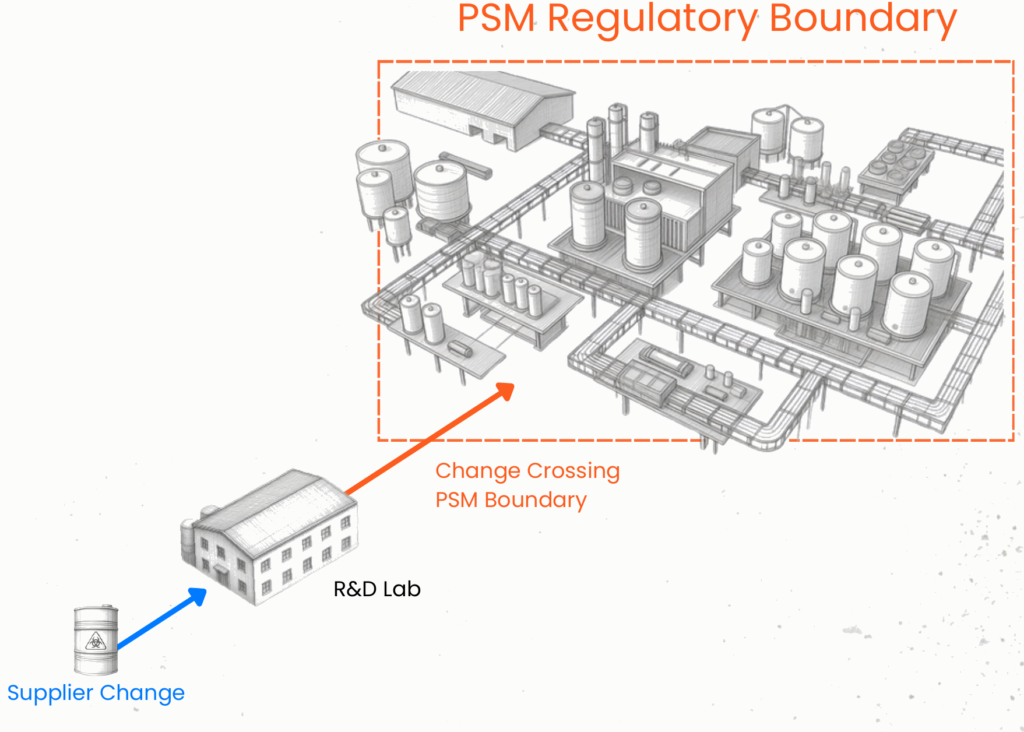
When every department is working under the same MOC expectations, you’ll have a defensible position if OSHA or EPA investigates an incident outside your PSM boundary using General Duty Clause authority.
Regulatory Reference
OSHA 29 CFR 1910.119: Process Safety Management of Highly Hazardous Chemicals
Employers must have written procedures to manage changes (except replacements in kind) to process chemicals, technology, equipment, and procedures, and to facilities that affect a covered process.
Required documentation for each MOC:
-
-
- Technical basis for the proposed change
- Impact on employee safety and health
- Modifications to operating procedures
- Time period for the change
- Authorization requirements
-
Before startup after a change:
-
-
- Affected employees must be trained
- Process Safety Information must be updated
- Operating Procedures must be updated
-
EPA 40 CFR Part 68: Risk Management Program
RMP-covered facilities face parallel MOC requirements under EPA regulations. The program applies to facilities that handle regulated substances above threshold quantities. MOC requirements mirror OSHA PSM in structure.
Program tiers:
-
-
- Program 1 = Lowest hazard (limited requirements)
- Program 2 = Moderate (simplified MOC requirements)
- Program 3 = Highest hazard (full PSM-parallel MOC)
-
Before startup after a change: affected employees must be trained, Process Safety Information must be updated, and Operating Procedures must be updated.
OSHA General Duty Clause: Section 5(a)(1) of the OSH Act
Employers must provide a workplace free from recognized hazards that are causing or likely to cause death or serious physical harm.
Why it matters for MOC: OSHA has applied this provision to facilities where incidents resulted from unreviewed changes, even when the facility was not PSM-regulated. This is the enforcement tool that closes the gap between the regulatory boundary and actual risk.
Applies to employers regardless of PSM coverage when a recognized serious workplace hazard exists.
EPA General Duty Clause: Section 112(r)(1) of the Clean Air Act
Facilities that produce, process, handle, or store extremely hazardous substances have a general duty to identify hazards and to design and maintain a safe facility.
Why it matters for MOC: EPA has used this clause in enforcement actions following incidents related to unreviewed changes at facilities that did not meet RMP thresholds. It applies regardless of whether the facility has a formal RMP obligation.
Applies to facilities handling extremely hazardous substances regardless of RMP threshold.
30-Minute MOC Health Check
List your last 10 changes in the rows below and work through each column. The goal is to identify where your program needs attention before an incident or inspection surfaces it for you.
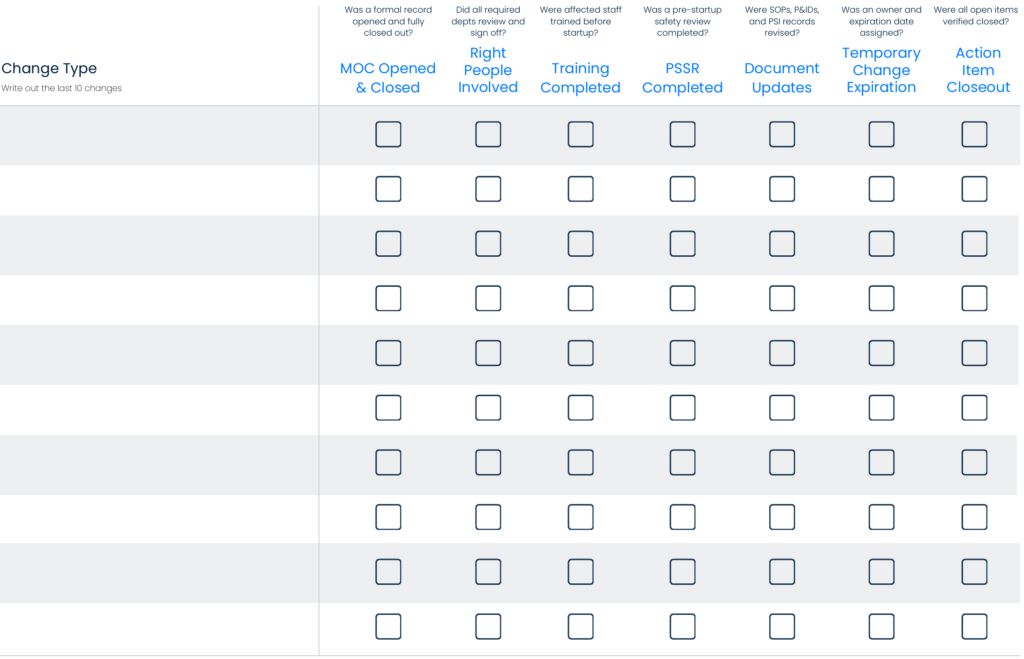
Column questions:
-
-
- MOC Opened & Closed: Was a formal record opened and fully closed out?
- Right People Involved: Did all required departments review and sign off?
- Training Completed: Were affected staff trained before startup?
- PSSR Completed: Was a pre-startup safety review completed?
- Document Updates: Were SOPs, P&IDs, and PSI records revised?
- Temporary Change Expiration: Was an owner and expiration date assigned?
- Action Item Closeout: Were all open items verified closed?
-
Make MOC easier to use, harder to skip, and quick to audit
With manual or paper-based MOC systems, you can’t prevent incomplete approvals from advancing, automate tracking for temporary change expirations, or quickly search records when an investigation asks what changed and when.
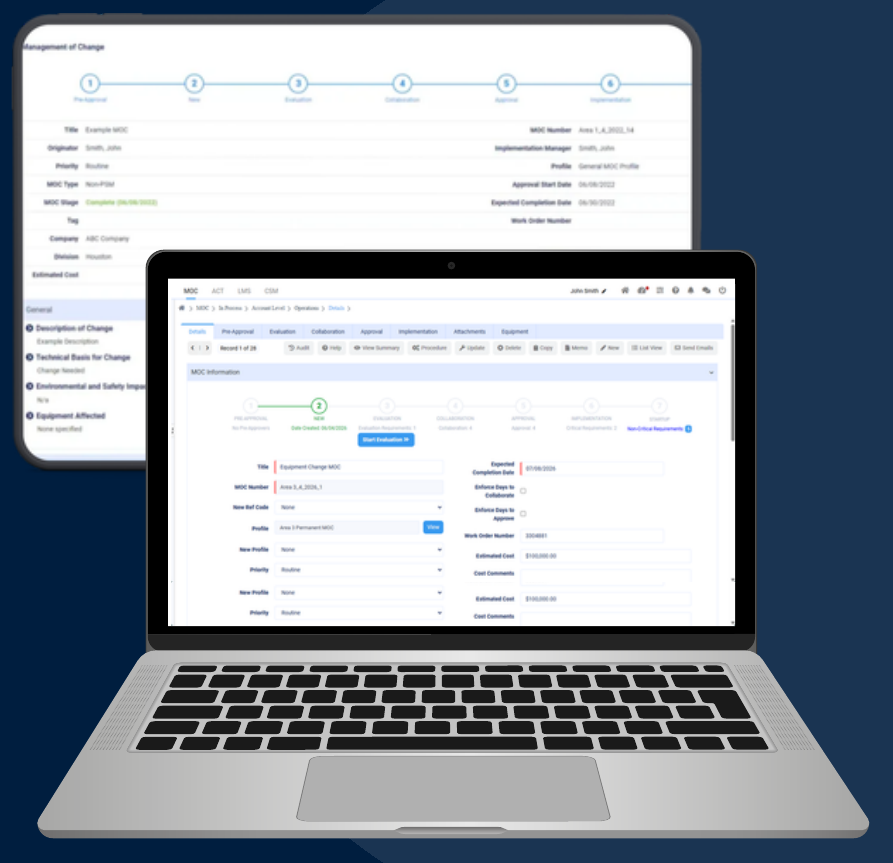 Frontline Removes Complexity Without Compromise
Frontline MOC gives EHS, process safety, and operations teams a simpler way to manage change. Automated workflows, configurable approvals, and centralized documentation help organizations reduce risk, stay compliant, and keep critical projects moving without losing visibility or control.
-
-
- Screen changes
- Route reviews
- Track temporary change expirations
- Connect action items and training
- Document PSSR
- Preserve the full audit trail in one searchable record
-
For more information about Frontline and its solutions, please visit the website.