New Products & Services
December 2025

Flow-Tronic
IFQ Logger 2 is a next-generation portable converter and data logger engineered for demanding wastewater and environmental monitoring applications. The new device is built for high performance across a wide range of field conditions and integrates with this company's existing sensor portfolio and external 4–20 mA sensors. This new model includes an IP67 enclosure and stainless steel reinforced connectors that ensure long-term resilience in harsh environments. Hot swappable battery capability allows continuous operation during maintenance or extended field campaigns. A built-in display with magnetic navigation provides instant access to recent values, alarms and data views, while the unit’s data-recovery function safeguards information in case of SD card loss or corruption. A quick system setup powered by the company's FUZION software allows for real-time velocity distribution and signal analysis, and efficient data download through a direct USB C connection. External data storage includes a 32 GB SD card supported by a 32 MB backup memory, enabling secure long term logging in .csv or .tsv formats. Together, these features help teams manage data more effectively and make faster decisions with reliable field insights. — Flow-Tronic N.V., Welkenraedt, Belgium
www.flow-tronic.com
Source: Valmet
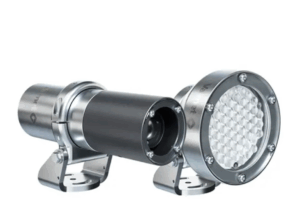
The recently renewed IQ Web Monitoring System (WMS) has been designed to elevate quality and efficiency in processing pulp, paper and tissue, as well as paper and board converting Fully integrated with this company's automation systems, the user interface of WMS enables operators to focus on situation-critical information and effortlessly trace defect origins. This seamless integration delivers real-time insights and advanced analytics that optimize the quality by enabling immediate detection of web defects and providing precise root cause identification. It simultaneously drives efficiency by reducing web breaks and unplanned downtime, enabling more stable production. The new system sets a new benchmark in image quality and usability. Equipped with two powerful LED light units, it delivers optimal illumination for sharper, more detailed visuals at resolutions up to 4K. The new camera is the most compact in its class, engineered for effortless installation, use, and maintenance. World-leading zoom pinhole optics further ensure reliable camera performance, even in the harshest environments. Its advanced thermal design provides exceptional high-temperature resistance while reducing operating costs and improving efficiency. The system features an updated user interface fully integrated with Valmet DNA and Valmet DNAe, giving operators a clear, real-time view of process performance. It provides easy access to recorded events and advanced tools for defect origin tracking and efficient root-cause analysis, enabling faster decisions and improved efficiency through seamless data integration. — Valmet Oyj, Espoo, Finland
Source: Chell Instruments
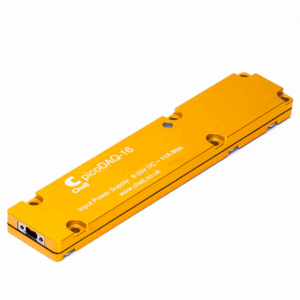
This company has launched its smallest digital-pressure scanner, the picoDAQ. Measuring just 83.4mm by 14.8mm by 9.6mm, the tiny dimensions of the picoDAQ make it ideal for high-accuracy pressure testing in applications where space is limited but precision remains critical. The picoDAQ can deliver up to 0.03% full-scale accuracy output. As a fully configurable smart pressure scanner, the new device can output pressure data in engineering units over Ethernet and Controller Area Network (CAN), using both CAN-FD and ‘classic’ CAN. The picoDAQ makes use of 17 absolute transducers which are thermally compensated and conditioned to provide 16 absolute or differential measurements relative to the one reference port. Due to its rugged outer casing and components that are sealed to IP67, the picoDAQ is especially valuable within product quality testing. — Chell Instruments Ltd., North Walsham, U.K.
Source: Chandler Engineering
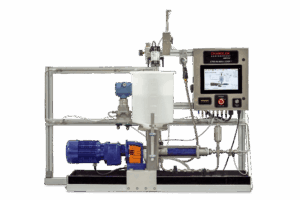
The 6700-M Mini Loop is a compact bench system designed for precise measurement of friction pressure in slick water fracturing fluids used in oil and natural gas processes. This latest addition to the 6700 Friction Flow Loop product line delivers advanced testing capabilities in a portable, space-saving design. This compact system evaluates the performance of friction reducers in fracturing fluids across a wide range of pressures and pipe diameters under controlled flow conditions. Leveraging this company's proprietary software, the system provides comprehensive data acquisition and analysis, granting operators full control over test parameters including duration and temperature. Throughout each test cycle, the system continuously captures and calculates critical data for accurate, repeatable results. With its low-volume fluid requirements, the 6700-M is ideal for quality control testing, enabling fast, repeatable assessments of fluid performance. It also serves as a powerful tool for research and development, allowing engineers to validate friction-reducing systems before scaling up to full-size loop testing. Additionally, its compact footprint and portability make it well-suited for use in field test laboratories, including on-site well locations where rapid fluid evaluation is essential. — Chandler Engineering, a business of Ametek, Tulsa, Okla.
Source: IMI
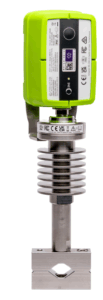
The NEON Sonic sensor is a a combined sound and temperature sensor for the acoustic wireless monitoring of steam traps and pressure/safety relief valves (PRV/SRV). NEON Sonic can measure sound pressure levels from 15 to 80 kHz and temperatures from -40°C to 450°C, providing plant engineers and managers with status reports to determine if steam traps are healthy, leaking or blocked. The sensor is IECEx/ATEX Zone 0 certified, making it suitable for use where there is a risk of explosion. Featuring a battery life of up to seven years, the sensor substantially reduces the need for plant maintenance teams to conduct regular manual inspections. It is also ideal as a retrofit solution, as it does not require a power supply or any modifications to existing equipment or infrastructure. Steam trap failure is a major issue for power plants, refineries and industrial facilities globally, accounting for the wastage of 15 to 20% of steam energy and making a significant contribution to overall levels of fugitive emissions. This creates challenges both for plants’ commercial and environmental performance. At the same time, steam trap faults can cause damage to equipment because of erosion where wet steam accumulates. Accurate monitoring can reduce unplanned downtime while ensuring routine maintenance is completed on time, reducing the costs incurred from taking a plant offline. Failing stream traps also pose a major safety hazard to personnel. Moreover, the manual inspections that are required where automatic monitoring is not in place are both expensive and hazardous, while providing less-frequent and less-accurate data on equipment performance and failures. The new sensor complements existing NEON Vibration Sensor, NEON Pressure Sensor and NEON Temperature Transmitter in use across energy and industrial applications globally. — IMI plc, Birmingham, U.K.
Source: SpinChem
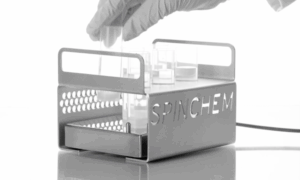
The SpinChem MiniRBR is a refillable, milliliter-scale rotating bed reactor (RBR) designed for rapid screening and reliable scaleup in biocatalysis and solid–liquid processes. Operating from just 5 mL, the MiniRBR enables fast parallel testing, reduced work-up, and enhanced mass transfer that closely mirrors the performance of larger RBR systems. Early studies at leading research institutions are confirming the performance of the MiniRBR.At the Institute of Technical Biocatalysis, TUHH (Hamburg University of Technology, Germany), researchers found approximately 50% higher apparent activity compared to suspended carriers under similar conditions. And at At UNESP (São Paulo State University, Brazil), the MiniRBR enabled a challenging dynamic kinetic resolution involving two incompatible catalysts. Its compartmentalization enabled high conversion rates and over 99% enantioselectivity, results difficult to achieve with conventional suspended catalyst systems. Built for daily use, the MiniRBR is refillable, easy to handle, and compatible with standard magnetic stirrers, allowing labs to parallelize quickly and scale results with confidence. The system provides several benefits over other similar laboratory systems in a number of situations, including:
• Immobilized biocatalysis, when mass transfer limits conversion
• Multi-solid workflows, where compartmentalization helps prevent catalyst incompatibilities
• Adsorption tasks such as color removal or scavenging, where consistent bed contact improves outcomes
— SpinChemAB, Umeå, Sweden

This company has launched a strategic collaboration to offer users of Emerson’s DeltaV™ automation platform with a global suite of advanced operational technology (OT) cybersecurity services. The collaboration gives DeltaV users the option to have a single, authorized cybersecurity services provider to simplify vendor management, accelerate project timelines, and enhance operational resilience across their entire OT environments. This level of streamlining results in faster project timelines and reduced vendor complexity, as well as consistent governance and the availability of OT-tailored services that reflect real-world risk to plant operations. As part of the new partnership, the following initial services to DeltaV Automation Platform users:
- Basic Cybersecurity Assessment: A low-cost, nonintrusive assessment of OT systems, including DeltaV DCS and SIS.
- Consequence-based Cybersecurity Risk Assessments: Two methodologies aligned to ISA/IEC 62443-3-2: CyberHAZOP, a safety-oriented, systematic study of OT cyber risks, and CyberBowtie, a streamlined, visual alternative.
- Network Intrusion Detection System (NIDS) Deployments: Turnkey design, implementation, and maintenance of OT NIDS with rapid rollout and precise tuning.
- OT Cybersecurity for Capital Projects: Unified Emerson and Armexa capabilities to design and deploy OT security aligned to ISA/IEC 62443-2-4
— Armexa, Houston, Tex.
Source: Brass Knuckle
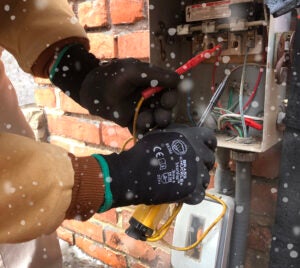
According to the National Institute for Occupational Safety and Health (NIOSH), workers exposed to extreme cold may be at risk of cold stress, a condition that lowers skin and core body temperatures and can lead to tissue damage or even death. This company's SmartFlex BK360 cold-weather work glove is engineered to keep hands warm, dry and productive in frigid conditions. Layer after layer of insulation protects against cold exposure while maintaining impressive flexibility and dexterity. SmartFlex BK360 begins with a 13-gauge nylon shell over a soft, 7-gauge napped acrylic liner for warmth and comfort. It is finished with a full foam latex palm and fingers — and three-quarter coverage on the back of the hand — for superior insulation and grip. Unlike standard coatings that stiffen in low temperatures, this product's foam latex stays pliable and responsive, preserving tactile control in cold environments. The sponge-like foam coating of the SmartFlex BK360 creates a strong, dry grip and draws moisture away from the palm surface in wet conditions to help maintain slip resistance (though latex is not recommended for oil exposure). The glove’s sleek black-on-black styling conceals dirt, while its seamless, stretchable knit wrist seals out debris and cold air. For those who work outdoors or in refrigerated environments, SmartFlex BK360 delivers the rare combination of thermal protection, dexterity, and comfort — helping workers stay compliant, focused and effective through the coldest shifts. — Brass Knuckle Safety Products, Alpharetta, Ga.
www.brassknuckleprotection.com
Source: Metso
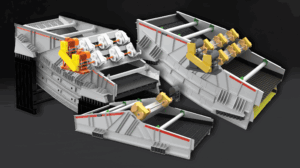
The Grande Series of screening solutions is specifically engineered to maximize productivity and efficiency in mining and aggregates operations and to meet the most demanding screening requirements. Covering three new stationary screen types — GLH, GMF and GFF — the new series is designed to help users handle even the most demanding, high-capacity 24/7 applications. The larger screen sizes within the Grande Series enables users to take advantage of enhanced capacity, reduced downtime, and greater operational flexibility to support their business targets. GLH Series horizontal screens are engineered for, among other things, heavy-duty slurry and water handling in demanding mining environments. GMF Series multi-slope banana screens offer high-capacity screening of both fine- and near-size particles. These new additions bring flexible engineered-to-order (ETO) configurations and very large screen designs to our portfolio – capabilities not previously available in Metso’s stationary screen range. Finally, the GFF Series, featuring flip-flow technology, enables efficient screening of challenging materials and fine separation, further strengthening our position as a comprehensive screening solutions partner. The Grande Series also includes Trellex® screening media compatibility, ensuring customers benefit from a complete solution that integrates seamlessly with Metso’s broader offering. Easier replacement of third-party screens and flexible configurations for replacements are key benefits of this new series, ensuring that customers can seamlessly upgrade or modify their existing setups. — Metso Corp, Espoo, Finland
Source: GFS Chemicals
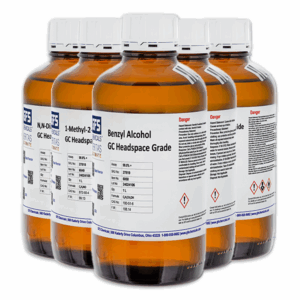
Veritas Ultimate GC-Headspace ultra-pure solvents are designed for pharmaceutical, food and environmental laboratories to deliver performance and precise results for gas chromatography (GC) headspace testing. Residual solvent analysis is critical for ensuring product safety and regulatory compliance, helping to ensure that products do not contain harmful impurities. Veritas Ultimate GC-Headspace solvents are engineered to eliminate interference, reduce volatile impurities and provide consistent, reproducible results. Veritas Ultimate GC-Headspace solvents are now available in five formulations: N,N-Dimethylacetamide (DMAc); N,N-Dimethylformamide (DMF); Dimethyl Sulfoxide (DMSO); 1-Methyl-2-pyrrolidone (NMP); Benzyl alcohol (BnOH). Each solution is offered in 1-L packaging for streamlined lab operations. — GFS Chemicals, Columbus, Ohio
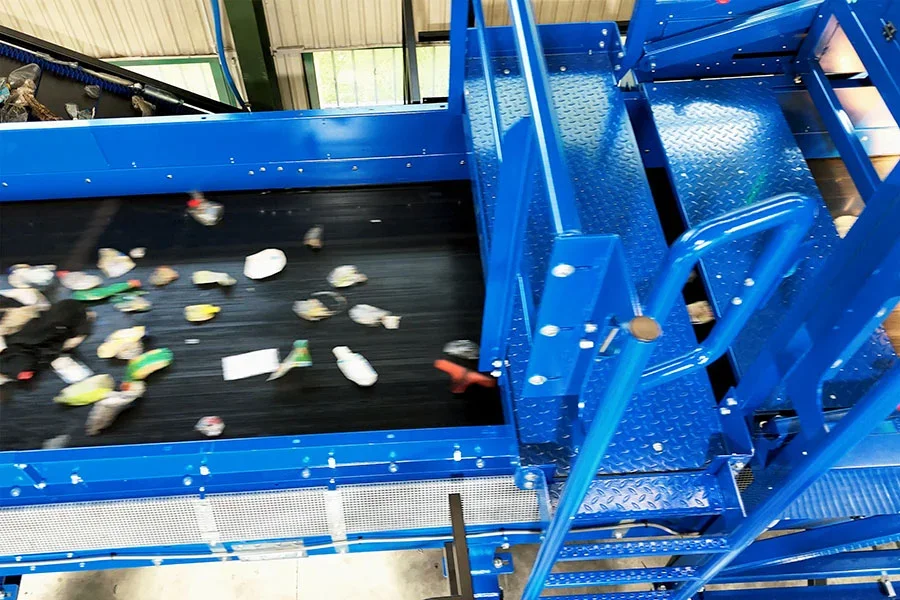
Developed in partnership with analytics specialist RTT System GmbH, this company has launched the BRT HARTNER AS Automatic Sorter, its first sensor-based and AI-supported separation platform for high-precision sorting for materials that cannot be processed using conventional separation methods. The AI can not only process all of the recorded data without loss and thus not only reliably identify the material but also differentiate objects into predefined object classes. This allows precise statements to be made about the material, ensuring that different types of plastic can be precisely differentiated for recycling purposes.
Source: Eggersmann Recycling Technology
The BRT HARTNER AS combines an acceleration belt, optical sensors and compressed-air sorting. And while many sorting systems rely on near-infrared (NIR) technologies, the AS system is equipped with the latest generation of hyperspectral imaging [HSI], says the manufacturer. This HSI camera system not only generates high-resolution images, but can also provide important information about the material properties. In addition, the use of a sensor fusion-base concept sets the BRT HARTNER AS system apart from other solutions on the market. Thanks to sensor fusion, the measured values of all installed sensors (NIR/color/3D/metal) are evaluated directly as raw data and there are no further interfaces. Thus, the data from all sensors are forwarded for analysis without loss. The detection algorithm has been trained on extensive data material and therefore proves to be extremely precise. The user can recognize the material assignment of the input material live on the system's intuitive display. In the case of lightweight packaging, for example, not only is the material assignment shown in color, but the type of packaging is also recorded and noted. The system's flexibility also means that new sensors can be integrated into the system at any time at the raw data level, supporting the retrofitting of 3D sensors, metal sensors or future marker technologies. If required, the standard spectral AI can also be expanded to include object AI (a color camera must be installed in this case), which recognizes and separates out precisely predefined objects. — Eggersmann GmbH, Halle, Germany

Source: KBC
Visual MESA® Energy Management System (EMS) version 7.3 is an advanced real-time, model-based, energy digital twin suite of applications. This latest release helps petroleum refining, petrochemicals and other energy-intensive industries drive reductions in both energy costs and emissions. It facilitates decision-making by combining real-time plant data with rigorous first-principles modeling. Built for complex, multi-facility environments, version 7.3 enhances flexibility, cloud readiness and connectivity to support energy cost reduction and decarbonization initiatives. This release improves the scalable, multi-objective optimization and optimal scheduling tools used to drive real-time performance and enable sustainable, autonomous operations. Enhanced API compatibility with the this company's Acuity™ Industrial Cloud Suite enables secure, scalable workflows for cloud-based multi-site energy management. External systems now trigger multi-period optimization (MPO) schedule runs to broaden forecasting and real-time optimization strategies. The platform also features a number of new modeling and forecasting capabilities, including an expanded simulation and optimization blocks library to optimize industrial clusters in real-time and evaluate transition options, and an intuitive, role-based user interface for forecasting and multi-period optimal energy scheduling. An updated internal historian and libraries address vulnerabilities for improved security. Visual MESA EMS v7.3 supports the shift from centralized, fossil-based systems to distributed, electricity-intensive architectures that include renewables and energy storage. By creating a digital twin model of the energy system, the software enables automatic, data-driven decisions that balance cost, decarbonization and operational priorities. The same energy system model applies from design to operations, in either open- or closed-loop configurations, to facilitate autonomous forecasting, optimal scheduling and real-time optimization. All energy sources from renewables and conventional fuels to power or products storage options can be modeled, managed, and optimized within a unified system. — KBC Advanced Technologies, a wholly owned subsidiary of Yokogawa Electric Corp., Walton on Thames, U.K.
Source: Wevo-Chemie
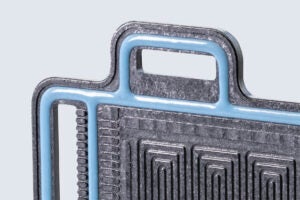
WEVOSIL 23010 and WEVOSIL 23030 are two new liquid silicone rubbers (LSRs) specially developed for silicone textile coatings and sealing applications. Both materials combine processability with high elasticity, temperature resistance and adhesion. They are said to enable new possibilities for precise and automated manufacturing processes using dispensing on textiles, plastics and metals. Designed for use under a wide range of environmental conditions, these two new LSRs offer a temperature range from –60 to +200°C and also have demonstrated high performance in thermal-shock tests. The mechanical properties of the materials have been optimized for the durability demanded by coating and sealing applications. WEVOSIL 23010 is a very soft LSR silicone that combines high elasticity with robustness, offering an elongation at break of over 900% and a tensile strength of 5.5 N/mm². It also provides good initial adhesion on textiles or polymer surfaces without the need for primers. The material is suitable as a silicone textile coating to reinforce technical textiles. It can also be used for permanently bonding textile layers and embedded electronics. These properties enable the manufacturing of smart textiles, such as protective clothing for firefighters or military applications as well as sportswear with extended functionalities WEVOSIL 23030 is a classic LSR silicone offering an elongation at break of over 500% and a tensile strength of 5.0 N/mm². After post-curing, the material exhibits good adhesion to substrates such as metals and plastics, making it particularly suitable for applications with demanding requirements in terms of long-term stability and temperature resistance. Dispensing capabilities open up numerous fields of application. A key focus is sealing as Cured- or Formed-in-Place Gaskets (CIPG or FIPG) in stacks and bipolar plates for fuel cells and electrolyzers, as well as the attachment of electronic components to clothing for extended functionalities. Supporting cross-linking without abrasive fillers means both of these liquid silicones can be precisely and reliably applied in fully or partially automated production processes. In addition, processing parameters, such as flow behavior, pot life and curing speed, can be accurately adapted to suit individual user requirements on request. This enables seamless integration into existing production lines or the use of alternative application methods alongside dispensing. — Wevo-Chemie GmbH, Stuttgart, Germany
Source: Krohne
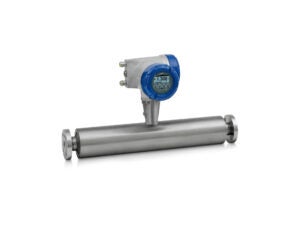
The the proprietary Entrained Gas Management (EGM) feature is a significant advancement for this company's Coriolis flowmeters. This innovation allows for continued operation in two-phase flow conditions, a situation that traditionally causes most Coriolis meters to cease functioning. EGM enables the meter to continue measuring repeatably without process interruption, even when accuracy may be slightly degraded from published specifications. Coriolis flowmeters are highly suitable in various sectors, including chemical processing, food-and-beverage production and oil-and-gas operations. These meters are particularly valuable in mass-based operations, recipe formulation, blending applications and scenarios where ownership changes are transacted. The meters further distinguish themselves in industry with a novel single straight tube design, offering benefits for challenging processes that cannot accommodate bent tube solutions. This design provides several advantages, such as lower pressure drop, easier installation and better handling of shear-sensitive fluids, according to the manufacturer. — Krohne Inc., Beverly, Mass.
Source: EagleBurgmann
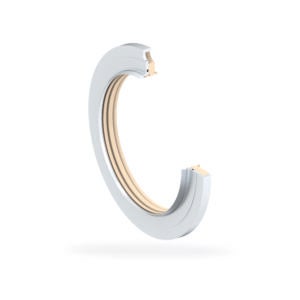
The new SeccoLipR seal component provides protection against particles entering the shaft seal, which can result in increased wear and unplanned downtime. Part of the SeccoLip seal series, it features a metal shield designed to reliably protect the PTFE sealing lips behind it from abrasion and ascending leakage. The result is a significantly longer service life for the seal, even with direct product contact. During operation, seals on shafts in machines and systems are constantly exposed to forces of varying strength and direction. Many lip seals struggle in this situation, which can result in increased wear, contamination that reduces quality due to leaks, or even complete seal failure. SeccoLip addresses many of these challenges by combining the operating principle of shaft sealing lips with the reliability and safety of a mechanical seal. The patented combination of a PTFE sealing lip and sliding part can directly and safely compensate for shaft deflections thanks to a special compensation function. The new SeccoLipR seal component enhances this concept by incorporating a metal shield that protects the lip seals behind it from abrasive substances, preventing damage and leaks. It also features a second PTFE lip that seals against the atmosphere, making it suitable for use in a vacuum. Compared to other solutions on the market, this second PTFE element offers an improved throttling function. Further advantages include the ability to combine the SeccoLipR component with other agitator seals and the option of using it as a single-seal solution. In addition to six standard sizes (40 mm, 50 mm, 60 mm, 80 mm and 100 mm), custom sizes are also available upon request. Applications for this seal include agitators, mixers, kneaders, dryers, reactors and screw conveyors with top or side drives. — EagleBurgmann Germany GmbH & Co. KG, Wolfratshausen, Germany
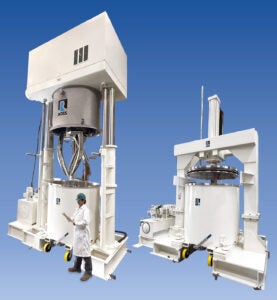
Source: Charles Ross
This company recently completed the largest Double Planetary Mixer in its U.S. history, a Model DPM-750 capable of mixing up to 750 gal per batch and engineered with safety features for a Class I, Div. 1, Group D hazardous environment. This heavy-duty mixer delivers the robust agitation required for ultra-high viscosity materials while adhering to demanding safety standards. A 150-h.p. inverter-duty motor powers a pair of high-viscosity (HV) stirrers that operate in a planetary motion ideal for turning over extremely thick, sticky, stiff or dense materials. Vacuum mixing to 29.5 in. Hg produces a void-free finished product and improves dispersion quality. The vacuum hood is customized to include various ports for ingredient charging, exhaust and observation. The mixer’s stainless-steel type 304 product contact parts are polished to an 80-grit finish, and interchangeable mix cans support flexible batch processing. The dual-post hydraulic lift features a 10-h.p. explosion-proof motor, dual hydraulic pumps and integrated locks with proximity switches for precise, secure positioning. Safety interlocks disable operation unless the stirrers and mix can are properly positioned. The accompanying ram-type discharge system is designed for fast, efficient product transfer and easy cleaning. A pressure-compensating hydraulic system maintains 60 PSI under the platen. In minutes, a 750-gal batch is pushed out of the 4-in flush tank ball valve at the bottom of the mix can, while the platen O-ring scrapes sidewall surfaces on its way down, maximizing yield. — Charles Ross & Son Co., Hauppauge, N.Y.