Paying attention to the seal design used in centrifugal pumps can help in water management. This article uses the beverage industry to illustrate this point
Economic survival in a climate where industry competition and environmental concerns converge is not easy. However, protecting the planet is becoming an ethical imperative for reasonable people. It is — or should be — matched only by an acute sense of self-preservation.
It gives us pleasure when we see these priorities beginning to line up nicely with legitimate and logical commercial interests. Commercial interests can rightly be summarized as low-cost production and high equipment reliability. That said, this article introduces the reader to factual details, proven achievements, and realistic goals as they pertain to the beverage industry.
Sustainability targets
In the beverage industry, targets are typically expressed as water-use ratio, or liters of water consumed per liter of beverage produced. Singling out the beer brewing industry, an entity fittingly using the acronym BIER (Beer Industry Environmental Roundtable) published benchmarking studies that show a steady improvement from 2013 to 2017 with the water-use ratio from 2.76 L/L (0.73 gal/gal) to 2.53 L/L (0.67 gal/gal) — an improvement of 8.3%.
In the beer-brewing segment of the beverage industry, the water-use ratio declined from 3.68 L/L (0.98 gal/gal) in 2017 to 3.35L/L (0.89 gal/gal) in 2018. This represents a welcome 9% reduction. However, many of today’s brewers have more ambitious targets and are reaching these by paying attention to pump-seal water-management matters.
Upgrade options
Modern breweries operate dozens of centrifugal pumps; these move liquids ranging from light slurries to ultra-clean final products. In the final products, even trace contaminants (solids) would be objectionable and proper sealing is important.
One of many possible mechanical seal configurations is generally used to seal between the pump casing and the rotating shaft. Such seals work by having two very flat surfaces, one connected to the rotating shaft, and the other connected to the stationary casing. Spring pressure is applied to one of the two faces, and pumpage cannot escape with the pump stopped and the seal faces contacting. When the pump rotates, the faces open about one micron, a gap approximately fifty times smaller than the diameter of a human hair. A miniscule volume of flush passes between the faces, thereby providing both lubrication and heat removal. For years, relatively low-cost mechanical seals similar to Figure 1 were used with water as the flush liquid.
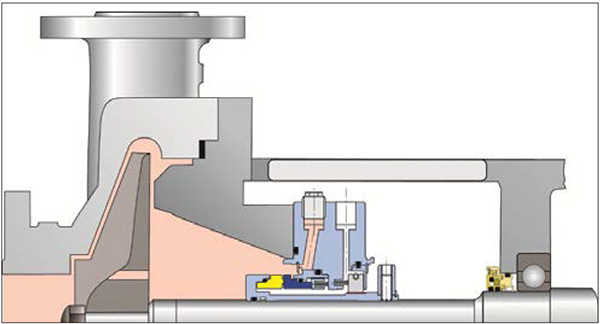
FIGURE 1. A typical mechanical seal with two traditional flush ports is shown here
In the decades since 1970, industry has applied the tried and tested seal configurations and seal flush applications described in the standards of the American Petroleum Institute (API). Among these we find the typical mechanical seal in Figure 1. Here, seal flush water can be connected to the top of the outer port. This water would contact the inside of a mechanical seal assembly and then exit from a diagonally opposite port to drain. If the user opted to connect flush water to the larger of the two flush ports, the flush liquid would mingle with the liquid contained between the impeller and taper-bored pump back plate. It would thus dilute the pumpage and, in many cases, would later have to be removed by evaporative means. Vacuum dehydration or evaporation (or both) by applying heat are among the available means of water removal, but both contribute to a facility’s operating expenses and wasted water, a valuable resource.
Usage figures tell the story. Suppose a user passes cool clean water through the smaller of the two flush entry ports and releases it to drain. In the brewing industry, this water flow is set to around 5.7 L/min (1.52 gal/min) per pump, which equates to about 3 million L (~800,000 gal) per pump per year. But suppose the user would be shown a well-proven way of eliminating 5.7 L/min (1.52 gal/min) of water use from 25 pumps. The user would thereby reduce water consumption by 74.9 million L/yr (~20 million gal/yr).
We had taken the average brewery’s numbers 740,812,000,000 L of water used and 221,106,000,000 L of beer produced from the BIER 2018 Benchmarking Study. The water-use ratio thus equaled 3.35. Accordingly, the new water-use ratio of 3.03 L/L translates into a reduction of 10%.
Water management systems
More recently, these reductions have been well documented [1]. The uneconomic ways of seal flushing described earlier are being superseded by the water management system shown in Figure 2.
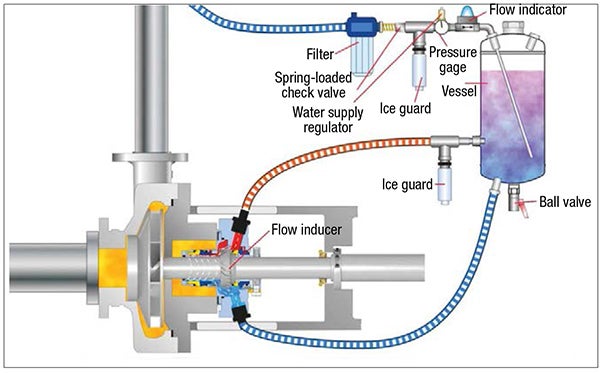
FIGURE 2. A self-contained (closed loop) seal water-management system is shown here (Source: AESSEAL, Inc., Rotherham, UK, and Knoxville, Tenn.)
This is a closed-loop system that recirculates the water in the mechanical seal. The system is pressurized by the plant’s water supply, ensuring that product remains in the pump. A flow indication instrument monitors system condition and readily detects leakage. Water management systems all but eliminate any significant consumption of seal water.
The vessel shown in Figure 2 is designed with a quick-release clamp allowing the bottom section of the tank to be removed for inspection and cleaning. Experienced manufacturers offer materials that are considered safe for use in food production.
Cost and potential ROI
Industry data suggest the benefits of eliminating the flow of sealing water and treatment of wastewater. Using the numbers in this article for 25 typical centrifugal pumps, yearly savings of $113,000 will be realized. The simple payback (return on investment; ROI) on this application will be less than 12 months in addition to gaining a 10% reduction in water-use ratio. In essence, all parties — including the environment — will benefit from this proven sealing technology.
Reference
1. Perez, Robert X. and Bloch, Heinz P., “Pump Wisdom: Essential Centrifugal Pump Knowledge for Operators and Specialists,” 2nd Ed., John Wiley & Sons, Hoboken, N.J., 2021.
Author
 Heinz P. Bloch is a consulting engineer at Process Machinery Consulting, and resides in Montgomery, Tex. (heinzpbloch@gmail.com). His professional career commenced in 1962 and included long-term assignments as Exxon Chemical’s Regional Machinery Specialist for the U.S. He has authored or co-written over 790 publications, among them 24 comprehensive books on practical machinery management, failure analysis, failure avoidance, compressors, steam turbines, pumps, oil mist lubrication and optimized lubrication for industry. Bloch holds B.S. and M.S. degrees (cum laude) in mechanical engineering from the New Jersey Institute of Technology. He is an ASME Life Fellow and was awarded life-time registration as a Professional Engineer in New Jersey.