Mentor Zoom is a new pan-tilt-zoom (PTZ) camera system designed for nondestructive testing (NDT) applications, purpose-built for visual inspection of confined spaces or hard-to-reach industrial environments. Designed for applications ranging from pressure vessels in chemical plants and petroleum refineries, to piping, as well as underground and storage tanks, sewers and nuclear facilities, the Mentor Zoom is engineered to perform in harsh conditions, including remote inspection and monitoring of repairs and maintenance operations up to 40 m underwater. The system comes with two full-HD camera heads, one 70-mm (10x optical zoom), one 130-mm (30x optical zoom). Both offer outstanding image and 60fps video signal quality as well as faster camera head movement. The 130-mm camera incorporates 4,000‑lumen built‑in illumination, delivering enhanced visibility and significantly extending inspection distance. The control unit features a removable touch screen with an integrated joystick and a 3-meter cable for easy handling during inspections. The cameras can be controlled with the joystick when protective gear such as heavy gloves are required. In normal operating conditions, the touchscreen’s touch-aim and zoom-to-rectangle function adjusts the pan, tilt and zoom parameters with effortless speed and its to-focus functionality allows operators to focus the camera with great precision.
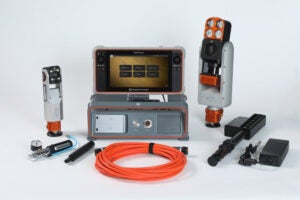
Source: Waygate Technologies
Mentor Zoom delivers reliable and repeatable industrial inspections by capturing accurate, textured 3D environmental views and automatically generating detailed 3D models for verification with digital twin features. With built‑in localization and advanced 3D scanning tools, it helps standardize workflows across technicians and sites, delivering consistent results that improve comparisons, reduce errors, and strengthen asset‑integrity decisions. The Mentor Zoom also sets new standards for documentation and reporting processes with on-device report generation and cloud connectivity, which save cost and time. Inspection results can be documented conventionally or marked and reported in 3D based on the automatically generated 3D mesh of the confined space environment. — Waygate Technologies, a Baker Hughes business, Houston