Before adopting Graph-RAG copilots for piping and instrumentation design, chemical process firms need data governance, safety guardrails and a clear human-in-the-loop workflow, not just a language model.
Every process engineer who has worked through Front-End Engineering Design (FEED) knows the pattern. You need a pump loop assembly for a new unit, and rather than designing from scratch, you search and dig through legacy piping and instrumentation diagrams (P&IDs) from previous projects, through vendor datasheets filed in three different systems, through email threads where the last revision was attached as a PDF. Industry surveys consistently find that knowledge workers spend around 25% to 33% of their day retrieving information instead of creating value [1]. In engineering, procurement and construction (EPC) firms, that search time is not just unproductive. It is where safety-critical details get missed and project schedules start to slip.
The question facing EPC leadership is not whether AI will touch P&ID workflows. It already has. The question is how to deploy AI copilots responsibly: reducing the retrieval burden, cutting rework cycles and preserving the safety accountability that regulators and clients demand. This article addresses the deployment question directly. It builds on the author’s prior research on P&ID copilots based on large-language models (LLMs) [2] and focuses on practical considerations for engineering organizations evaluating these tools for industrial implementation.

The real cost of P&ID rework
The inefficiency in P&ID creation is rarely a failure of CAD software. Platforms such as AVEVA Diagrams, Smart P&ID and AutoCAD P&ID are mature drafting environments. The problem sits upstream: the knowledge governing how components should be arranged (for instance, which valve configuration satisfies process requirements and ISA 5.1 symbology standards [3]; or which relief device sizing meets API 520 criteria for a given service) is scattered across documents that predate the current project team.
Recent engineering research highlights that non-standardized metadata across disparate asset systems forms the primary barrier to automated diagram interpretation, forcing technical personnel to expend a third of their billable hours on manual data retrieval rather than design optimization. This persistence of legacy data silos means that minor modifications compound unchecked across project phases, resulting in inconsistent equipment tagging, duplicated typical assemblies drawn differently each time and safety devices present on one revision but missing on the next.
What makes this problem tractable now is that three supporting technologies have matured enough to work together. LLMs handle natural language understanding. Knowledge graphs provide structured engineering data. And standards-based interchange formats, such as DEXPI XML [5], allow machine-readable representation of P&ID content. Together, they make a constrained AI copilot feasible. The word “constrained” is doing real work in that sentence. Unconstrained AI generation is not acceptable for safety-critical engineering deliverables, and recent research in process systems engineering has begun to define where that boundary sits [6, 7].
Why a language model alone is not the answer
There is an appetite across EPC for AI tools that speed up routine design tasks. But deploying a large language model directly into a P&ID workflow, without structural guardrails, creates a category of risk that engineering leaders cannot accept.
LLMs are probabilistic text generators. They produce plausible output, not necessarily correct output. When asked to generate a pump suction arrangement, an unconstrained model may omit a required drain valve, invert the sequence of check valve and isolation valve, or specify an instrument that does not exist in the project’s approved vendor list. These are not edge cases. They are the expected behavior of a system trained on general text corpora rather than validated engineering knowledge.
Evidence from adjacent domains quantifies how much grounding helps. In clinical question-answering, researchers found that coupling an LLM with an ontology-driven knowledge graph reduced hallucination rates from over 60% to under 2% [8]. That study addressed a medical domain rather than process design, but the underlying mechanism transfers: constraining the model to retrieve from a curated, validated knowledge source rather than generating freely from its training data. For P&ID work, the curated source is a knowledge graph built from the firm’s own validated designs, equipment specifications, and applicable standards.
The architectural pattern that achieves this constraint is called Graph-RAG: Retrieval-Augmented Generation grounded in a knowledge graph. A recent study demonstrated a working implementation of this pattern for P&IDs, using DEXPI-formatted diagrams cast into labeled property graphs that an LLM could query through graph-based retrieval [9]. It is not a product that EPC firms buy off the shelf. It is a deployment architecture that firms must build, or commission, around their own engineering data.
What Graph-RAG copilots do in practice
From the engineer’s perspective, a Graph-RAG copilot works as an intelligent retrieval and assembly tool. The engineer describes what they need in plain language — for instance: “Generate a centrifugal pump loop with suction strainer, 3-in. discharge check valve, and pressure-safety valve sized for 150-psig relief per API 520.” The copilot does not invent a design. It retrieves validated components from the knowledge graph, assembles them according to encoded sequencing rules (suction before pump, pump before discharge, discharge before relief device), validates the assembly against engineering constraints and presents the result for human review in a standards-based interchange format (DEXPI XML) that integrates with the firm’s CAD environment.
Three characteristics distinguish this tool from a conventional AI chatbot.
First, the copilot cannot fabricate components. If the knowledge graph does not contain a validated configuration for the engineer’s request, the system returns a gap notification rather than a hallucinated design. Recent work on P&ID question-answering confirms this: converting P&IDs into labeled property graphs and querying them with LLM-generated Cypher queries enables precise retrieval without fabrication, validated across 64,000 question-answer pairs spanning 500 P&ID sheets [10].
Second, every output is traceable. The copilot logs which knowledge graph nodes were retrieved, which rules were applied, and which constraints were checked. This audit trail satisfies the traceability requirements of OSHA PSM [4], EPA Risk Management Plans and client-mandated design review processes.
Third, the engineer remains the accountable decision-maker. The copilot drafts; the engineer approves. AI-generated P&ID content has no regulatory standing as an engineering deliverable. The signing engineer retains full accountability, and the Graph-RAG architecture is designed to support that accountability, not circumvent it.
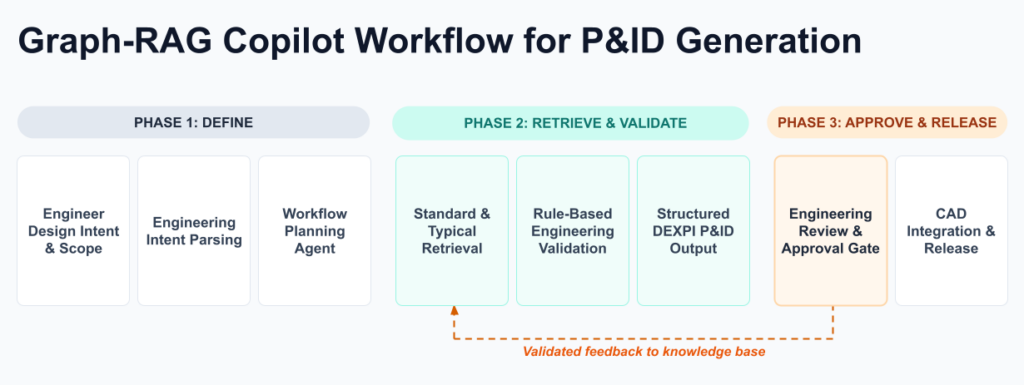
FIGURE 1. Graph-RAG copilot workflow showing controlled P&ID generation through retrieval, validation, structured output and engineer approval
Choosing the right AI approach for P&ID work
Not every P&ID task requires a Graph-RAG copilot. Engineering leaders evaluating AI deployment should match the tool to the task.
Rule-based automation remains the correct choice for highly standardized typicals: pump seal flush systems, utility headers, standard instrument hookups — cases where the design space is fully defined and variation is minimal. Recent work has shown that rule-based methods operating on graph representations of P&IDs can detect and autocorrect common design errors, with 33 engineering rules validated against DEXPI-standard diagrams [11]. These systems are deterministic, auditable and well understood. Their limitation is that they cannot handle novel configurations or cross-standard reasoning.
LLM-based assistants (without knowledge graph grounding) are appropriate for lower-risk support tasks: summarizing equipment datasheets, answering natural language queries about project documents or drafting meeting notes. They should not generate safety-critical design outputs.
Graph-RAG copilots are appropriate when the task involves assembling validated components into configurations that are not pre-templated, reasoning across multiple standards simultaneously (ISA, API, ASME, project-specific specifications), or retrieving engineering knowledge from heterogeneous document sets. The added complexity of building and governing a knowledge graph is justified when the rework cost and safety risk of unstructured approaches exceed the infrastructure investment.
The decision criterion is not which tool uses the most advanced AI. It is whether the task requires constrained retrieval from validated engineering knowledge or can be handled by deterministic rules or unconstrained text assistance.
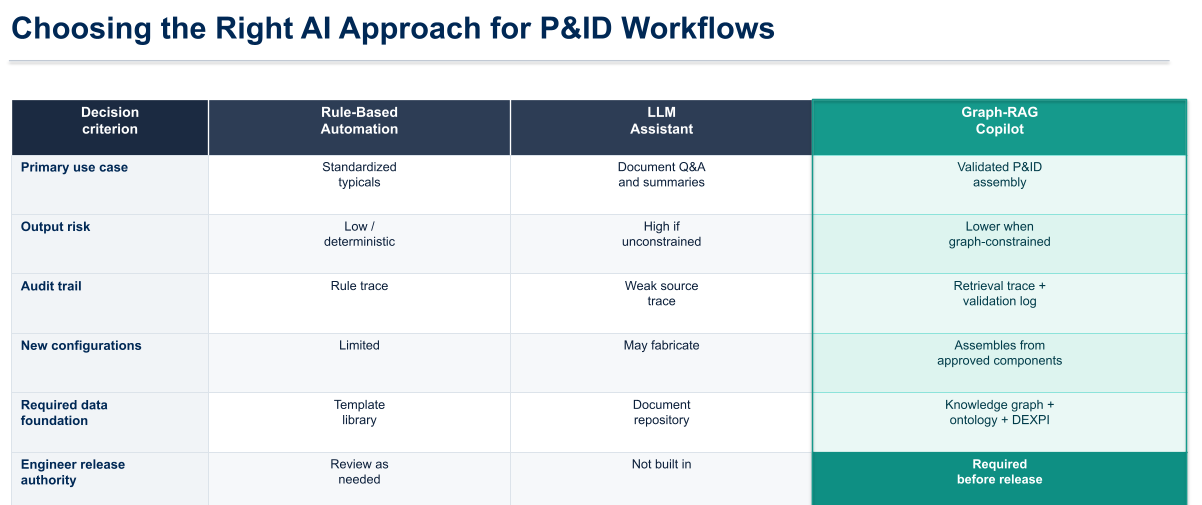
FIGURE 2. Comparison of rule-based automation, LLM assistants and Graph-RAG copilots for P&ID workflow applications.
What must be in place before deployment
Graph-RAG copilots require foundational data infrastructure that most EPC firms do not yet have. Engineering leaders considering deployment should assess their organization against five readiness criteria.
Standardized tagging and nomenclature. Equipment tags must resolve consistently across P&ID software, the DCS historian, the materials management system and cost databases. If a pump is P-101A in the P&ID, 101-PA in the DCS and Pump A in the procurement system, the knowledge graph cannot reliably link these entities. Non-standardized metadata in P&IDs has been identified as one of the principal barriers to automated interpretation, requiring semantic methods to bridge the gap between what engineers write and what machines can parse [12]. Tag reconciliation across systems is a prerequisite, not a parallel activity.
Machine-readable legacy data. The knowledge graph is only as comprehensive as the validated designs it ingests. Firms whose historical P&IDs exist only as scanned PDFs or DWG files without intelligent attributes must invest in digitization. Deep-learning-based inspection of P&ID object recognition now achieves 100% recall for unrecognized objects and over 95% F1 scores for symbol recognition, reducing manual error-correction time by approximately 40% [13]. A practical pilot scope would be to convert 50 to 100 representative P&IDs from recent projects into DEXPI XML over a three- to six-month period. This provides a minimum viable knowledge base.
Ontology governance. The ontology — the formal vocabulary defining equipment classes, valid relationships, and constraint rules — requires ongoing maintenance. Standards evolve (ISA 5.1 was most recently updated in 2022), new equipment types enter service and project-specific conventions must be encoded. A firm that builds an ontology but does not staff its maintenance will find the copilot’s knowledge base stale within two years.
Integration with existing CAD and data systems. The copilot must exchange data with the firm’s CAD platform (typically via DEXPI XML [5] or native API), with document management systems where standards are stored, and with project controls databases where tag assignments originate. Instrument typical expansion — one of the highest-volume P&ID subtasks — has been automated using computer vision and domain knowledge rules, achieving precision above 98% and recall above 99% when the underlying data is structured [14]. Early integration work should target similarly high-value, low-risk interfaces: tag lookup, typical assembly retrieval and document Q&A.
Defined human-in-the-loop checkpoints. Before deployment, the firm must define exactly where in the P&ID workflow an engineer reviews and approves copilot outputs. Ambiguity here is unacceptable. The review checkpoint must be documented in the project execution plan, and engineers must be trained on how to evaluate copilot-generated DEXPI output, including how to identify when the copilot has applied an outdated standard or retrieved a component from an inappropriate design-basis context.
Implementation risks engineering leaders should anticipate
Three categories of risk deserve specific attention.
Ontology incompleteness. If the knowledge graph lacks coverage for a particular equipment class or configuration, the copilot will either return no result (safe but unhelpful) or retrieve a partial match that the engineer must carefully evaluate. Incomplete ontologies produce partial value rather than full automation. Firms should scope their initial deployment to the 20% of assemblies that account for 80% of repetitive redrawing.
Over-trust and automation complacency. Engineers who become accustomed to copilot output may reduce their scrutiny of generated assemblies over time. This is the same complacency risk that process safety literature documents for alarm management and control-system overrides. Mitigations include mandatory independent review of copilot outputs during early deployment, periodic accuracy audits and organizational reinforcement that the copilot is a retrieval tool, not an engineering authority.
Vendor lock-in and model drift. If the copilot’s LLM component is served by a third-party API, model updates (which may occur without notice) can alter output behavior. Firms should maintain validation test sets — known-correct P&ID assemblies that are re-tested after any model update — and retain the ability to pin or roll back model versions in production.
The path forward for EPC firms
Fully autonomous P&ID generation is not supported by current evidence, regulation, or organizational readiness. The path forward is incremental: fix data governance, deploy constrained copilots for high-value retrieval tasks and expand scope only when the infrastructure, organizational trust and regulatory clarity warrant it.
For engineering leaders evaluating Graph-RAG copilots today, the decision comes down to three questions.
Is the rework burden in P&ID workflows large enough to justify the data infrastructure investment? For most firms running repeated FEED and detail-design projects, the answer is yes. The pain is big enough. Are the organization’s tagging, nomenclature, and legacy data ready enough to build a minimum viable knowledge graph? If not, that is where to invest first. The AI copilot is the second step, not the first. Can the firm define and enforce human-in-the-loop checkpoints that satisfy both internal governance and regulatory accountability? If the answer is uncertain, the deployment is premature.
When those three conditions are met, Graph-RAG copilots offer a measured, auditable, and safety-respecting path to reducing the engineering rework that has burdened EPC projects for decades. ♦
Edited by Mary Page Bailey
References
- Cottrill Research, “Various Survey Statistics: Workers Spend Too Much Time Searching for Information.” https://cottrillresearch.com/various-survey-statistics-workers-spend-too-much-time-searching-for-information/
- Shinde, R. and Bhosale, V. A., Conceptual Framework of LLM-Based Copilots in EPC Firms for Automated P&ID Generation Using Knowledge Graph-RAG and Multi-Agentic Workflows, Frontiers in Emerging Engineering & Technologies, vol. 3, no. 1, February 2026.
- ISA-5.1-2022, “Instrumentation Symbols and Identification,” International Society of Automation, 2022.
- OSHA, “Process Safety Management of Highly Hazardous Chemicals,” 29 CFR 1910.119, U.S. Department of Labor.
- DEXPI Initiative, DEXPI P&ID Specification, Data Exchange in the Process Industry, version 1.4. https://dexpi.org/.
- Decardi-Nelson, B., Alshehri, A. S., Ajagekar, A., and You, F., Generative AI and Process Systems Engineering: The Next Frontier, Computers & Chemical Engineering, vol. 187, August 2024.
- Woo, T., Kim, S., Tariq, S. et al., Leveraging Generative AI and Large Language Model for Process Systems Engineering: A State-of-the-Art Review, Korean Journal of Chemical Engineering, vol. 42, pp. 2,787-2,808, 2025.
- Ke, Y. et al., Ontology-grounded knowledge graphs for mitigating hallucinations in large language models for clinical question answering, Journal of Biomedical Informatics, vol. 163, 2026. (Cross-domain analogy for knowledge-graph grounding.)
- Alimin, A. A., Goldstein, D. P., Balhorn, L. S., and Schweidtmann, A. M., Talking like Piping and Instrumentation Diagrams (P&IDs), Proc. ESCAPE35, Ghent, Belgium, 2025, arXiv:2502.18928.
- Gupta, M., Wei, C., Czerniawski, T., and Eiris, R., PIDQA: Question Answering on Piping and Instrumentation Diagrams, Machine Learning and Knowledge Extraction, vol. 7, no. 2, 2025.
- Balhorn, L. S., Schweidtmann, A. M. et al., Rule-Based Autocorrection of Piping and Instrumentation Diagrams (P&IDs) on Graphs, Proc. ESCAPE35, 2025, arXiv:2502.18493.
- Shteriyanov, V., Dzhusupova, R., Bosch, J., and Olsson, H. H., From Text to Meaning: Semantic Interpretation of Non-standardized Metadata in Piping and Instrumentation Diagrams, Computers & Chemical Engineering, 2026.
- Kim, J. B., Moon, Y., Han, S. T. et al., Automated Inspection of P&ID Object Recognition Using Deep Learning, Scientific Reports, vol. 15, article 39031, 2025.
- Shteriyanov, V., Dzhusupova, R., Bosch, J., and Olsson, H. H., “Automating the Expansion of Instrument Typicals in Piping and Instrumentation Diagrams (P&IDs),” Proc. IAAI-25, AAAI, 2025.
Author
 Rohit Shinde (Email: rohit.shinde2290@gmail.com) is a Senior Process Engineer at Atlas Prediction Control, and an Industrial AI Strategist based in Houston, Texas. He brings over a decade of experience in the design and scale-up of world-scale polyethylene and petrochemical facilities. He holds a B.S.Ch.E., an M.S.Ch.E. degrees, as well as an MBA from the University of Texas at Austin. His current work applies knowledge graph architectures, Graph-RAG frameworks and large language model (LLM) copilots within safety-critical EPC workflows. He has presented his frameworks for LLM-based design copilots at AIChE meetings, including the Spring and upcoming Fall 2026 meetings.