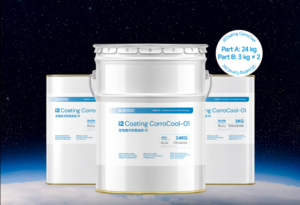
CorroCool is a new functional coating designed to protect industrial metal surfaces from both excessive heat and corrosion, combining this company’s passive radiative cooling materials with a high-solids silane polymer system. The result is an integrated coating that delivers cooling, corrosion protection and weather resistance without requiring electricity, water or mechanical cooling equipment. The product is intended for metal roofs, petrochemical storage tanks, outdoor electrical equipment, telecommunications cabinets and other metal infrastructure exposed to intense sunlight or corrosive environments.
Source: I2Cool
Industrial metal assets often face two interconnected challenges. Under direct summer sunlight, the surface temperature of metal roofs, storage tanks and outdoor cabinets can reach approximately 60–80°C. Because metal conducts heat efficiently, this heat can quickly transfer into buildings, stored materials or sensitive equipment, increasing cooling demand, accelerating component ageing and affecting operational stability. At the same time, exposure to moisture, salt spray, chemicals and airborne pollutants can lead to corrosion, particularly in coastal areas, chemical facilities and other high-corrosivity environments. Conventional corrosion-resistant coatings primarily act as protective barriers but do not actively manage solar heat. Thermal-control coatings, meanwhile, may not provide the level of corrosion protection required for demanding industrial applications. CorroCool was developed to address both issues within one coating system.
Metal surfaces contain microscopic irregularities, chemically active areas and potential defects. Effective protection therefore depends on how well a coating wets, penetrates and bonds to the substrate, as well as its ability to block the movement of oxygen, water and ions. CorroCool uses a high-solids silane polymer as its primary film-forming material. During curing, silane groups hydrolyse to form silanol groups, which react with hydroxyl groups on the metal surface and create strong Si–O–metal bonds. This molecular-level bonding helps anchor the coating to the substrate. Condensation between silane molecules also forms a dense three-dimensional network, creating a physical barrier against moisture and corrosive substances. Applied at a recommended total dry-film thickness of 200–250 μm, the coating combines the following: chemical bonding with the metal substrate; a dense physical barrier against corrosive agents; and nano-functional particles that provide passive radiative cooling. Laboratory testing has recorded adhesion strength above 10 MPa under specified test conditions.
The cooling mechanism incorporated into CorroCool is inspired by the Sahara silver ant, whose microscopic hair structure helps it survive extreme desert heat by reflecting sunlight and emitting body heat as mid-infrared radiation. The passive radiative cooling technology applies a similar principle to engineered materials. CorroCool provides two complementary thermal functions: High solar reflectance (Solar reflectance of at least 92% helps prevent a large proportion of incident solar energy from being absorbed by the metal surface); and High thermal emittance (Emittance of at least 95% within the 8–13 μm atmospheric window allows heat to be released as mid-infrared radiation toward the cold outer atmosphere).
By simultaneously reducing solar heat absorption and enhancing thermal emission, CorroCool can continuously cool coated surfaces without consuming electricity. For industrial facilities, this can help reduce surface and internal temperatures, lower cooling loads and limit temperature-related losses, including the evaporation of volatile materials from storage tanks. CorroCool has been engineered for high-corrosivity and outdoor industrial conditions, including: C5 high-durability corrosion protection in accordance with the relevant requirements of ISO 12944-6; Salt-spray resistance of at least 1,440 hours; Acid and alkali resistance of at least 240 hours; and 1,500 hours of xenon-arc weathering, with approximately 12% gloss loss and a color-change rating of Grade 1.
These properties make the coating suitable for coastal infrastructure, petrochemical facilities, power equipment, industrial buildings and arid environments with high solar exposure. The product also features a primer-and-topcoat integrated design. This reduces the need for separate anticorrosive primer and thermal-control topcoat systems, helping simplify application and shorten project schedules. High tank-surface temperatures can increase evaporative or “breathing” losses of volatile materials, leading to product loss and additional emissions. By lowering solar heat absorption, CorroCool can help reduce tank temperatures and associated evaporation while providing protection against chemical exposure humidity and salt spray.
Electronic components housed in outdoor cabinets are highly sensitive to temperature. In coastal and industrial areas, these enclosures may also be exposed to severe corrosion. CorroCool helps manage external heat gain, protect the metal enclosure and support more stable conditions for internal equipment. Additional potential applications include power facilities, offshore and coastal infrastructure, industrial pipelines, metal containers and outdoor manufacturing equipment.
Designed for efficient field execution, CorroCool features a primer-and-topcoat integrated formulation that simplifies surface preparation and coating application. By eliminating the need for separate anticorrosive primers and heat-reflective topcoats, the single-system application significantly streamlines project workflows, reduces labor costs, and shortens maintenance downtime for large-scale industrial facilities.
Rather than adding a cooling layer to a conventional anticorrosive coating, CorroCool treats the metal surface as an integrated functional interface: silane chemistry anchors the coating to the substrate, a dense polymer network provides corrosion resistance, and nano-functional materials regulate heat through solar reflection and radiative emission. — I2Cool Ltd., Hong Kong