A regulatory deadline rarely reaches into every document a site keeps on file, yet that is close to what OSHA’s 2024 revision of the Hazard Communication Standard set in motion. The rule folds the seventh edition of the Globally Harmonized System (GHS), together with selected elements of the eighth, into 29 CFR 1910.1200, and OSHA’s own economic analysis projects that close to 94% of safety datasheets currently in circulation, and 64% of shipped container labels, will require revision before the compliance window closes. For an engineer responsible for a chemical inventory of any size, that projection raises a question worth sitting with. Once a wave of updated sheets begins arriving from suppliers, where do they go, what happens to the version each one replaces and how would anyone confirm, six months later, that the library reflects the update rather than the document it superseded?

A document that answers to more than one standard
For much of its regulatory life, the safety datasheet has functioned chiefly as a hazard communication record, a document kept on file to satisfy 1910.1200 and produced if a worker or inspector asks to see it. The standard most closely associated with major chemical releases, OSHA’s Process Safety Management rule under 29 CFR 1910.119, draws on that same document for a separate purpose. Under 1910.119(d), employers compiling Process Safety Information on highly hazardous chemicals may use current safety datasheet information toward meeting that requirement, supplemented with process chemistry data specific to the operation, according to OSHA’s own compliance guidance in Appendix C of the standard. Viewed in this light, a sheet that has fallen behind its manufacturer’s latest revision carries a consequence reaching past the filing cabinet, since it becomes an input the plant draws on when judging how a process might fail.
A second obligation draws on the same underlying data. Under the Emergency Planning and Community Right-to-Know Act, operations storing dangerous chemicals above certain threshold quantities, generally 10,000 pounds for substances requiring a safety datasheet, submit Tier II inventory filings to state and local emergency planning authorities each year by March 1. A technical amendment published in the Federal Register in late 2025 brought those filing categories into correspondence with the 2024 Hazard Communication revisions, which means the classification data behind one submission now applies to the other as well. These three compliance streams, covering classification disclosure, process safety information and emergency planning, therefore draw from a single pool of chemical data, and the condition of that pool, whether it reflects the manufacturer’s current revision or an earlier one, has a bearing on all three.
The point at which a library stops behaving like one
An operation managing a handful of chemicals rarely runs into trouble here. The difficulty appears once a site accumulates the inventory typical of a process plant, which can run into the thousands of distinct products across multiple units, often supplied in several languages where activities span national borders. “Hazard Communication” has held the second position on OSHA’s list of most frequently cited standards for several years running, with 2,888 citations recorded in fiscal year 2024 alone. The violations behind that figure tend to involve sheets that are missing, outdated, or mismatched against the substance actually present on the shelf — a pattern that points to a distinction worth drawing between two related but separate properties of an SDS library, namely completeness, in the sense that every chemical has a sheet on file and currency, which refers to every sheet reflecting the manufacturer’s latest classification. A library can register as complete during a quick count and fail entirely on the second measure.
The international dimension compounds the picture. The United Nations revises the Globally Harmonized System on a recurring two-year cycle, with the eleventh revised edition released in 2025, and individual jurisdictions adopt each revision on their own timelines rather than simultaneously. A company receiving chemicals from suppliers across several countries can hold safety data sheets reflecting different GHS revisions for the same substance, each technically current under its own jurisdiction’s adoption schedule at the time it was issued. Reconciling that picture by hand, across a library running into the thousands of records and several languages, is the kind of task that consumes a safety department’s calendar and produces little that shows for it at the end of the week.
Indexing a single safety datasheet by hand calls for pulling product identifiers, CAS numbers, classification codes and concentration ranges out of a PDF that may follow any of dozens of supplier templates and arrive in a different language from the one before it. Multiply that across a few thousand products and a quarterly stream of supplier revisions, and the task outpaces what most safety departments can absorb through scheduled review cycles. A 2024 study in Scientific Reports, describing an automated indexing system built for exactly this purpose, characterized manual indexing of safety datasheets as “labor-intensive, time-consuming and costly.” Given the scale involved, that description tracks with what most plant safety teams would recognize from their own experience.
What an extraction pipeline can reasonably promise
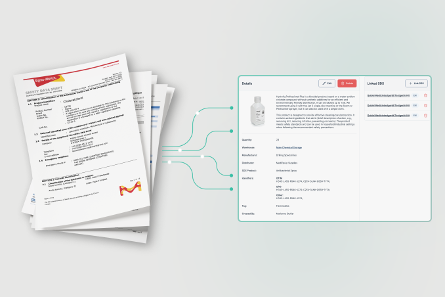 This is the area where document processing tools, especially the optical character recognition (OCR) and natural language processing (NLP) methods now common in AI-assisted systems, find a natural fit. OCR converts a scanned or image-based PDF into searchable text. After that, NLP models trained on the sixteen standardized GHS sections can locate and pull the relevant fields regardless of how a particular supplier has laid out its template or whichever language the document was issued in. The same Scientific Reports study reported a document-level precision of 0.93 across a test set of 20,000 annotated safety data sheets, a figure that gives plant engineers a reasonable benchmark for weighing automated extraction against the manual alternative at any meaningful scale.
Consider an operation that sources solvents from suppliers in Germany, China and the U.S., each issuing safety datasheets in its own language and format. An extraction system built around this kind of model can pull the CAS number, the GHS pictograms and the hazard and precautionary statements from each version, match the three records to a single internal product code, and flag any case where the classification differs across versions rather than simply reflecting a translation. Once a sheet’s fields exist as structured data rather than text inside a scanned image, a further comparison becomes possible, in which the system checks a stored record against a supplier’s published revision history and flags any sheet whose classification predates a known update, including those triggered by a GHS revision cycle.
The architectural choices behind a build like this
Building a system that performs this kind of extraction and comparison is itself an engineering project. The choices involved tend to follow a recognizable pattern once a team has worked through them, covering what models handle particular document types, how extracted fields map onto a database schema that preserves version history rather than overwriting it, and how the resulting search index becomes available to the people who need it during an audit or an incident response. Teams that have documented this kind of build tend to converge on a similar set of architectural decisions, regardless of the specific chemical inventory involved or the industry the operation serves.
A place within an established discipline
This work fits within a longer-standing body of process safety documentation practice. The Center for Chemical Process Safety, part of the American Institute of Chemical Engineers (AIChE), addresses chemical data management within its broader guidance on process safety information, describing accurate and current data as a foundation underlying both hazard analysis and emergency response planning. Framed within that discipline, an SDS management system capable of extraction, multilingual matching, and version comparison functions as a contribution to the data layer that several distinct process safety activities draw from, rather than as an isolated compliance tool.
Where professional judgment still has the final word
A precision figure of 0.93 means that, on average, something close to one document in fourteen will need a person to step in and correct the extraction. For most products in a typical inventory, that correction amounts to a minor task, a misread CAS number or a classification statement assigned to the wrong section. For substances classified as highly hazardous under 1910.119, the stakes attached to that one-in-fourteen sheet run considerably higher, given that its data may feed directly into a process hazard analysis. OSHA’s Process Safety Management rule already places responsibility for that analysis with people who hold the qualifications for it, a requirement that automated extraction leaves untouched. What changes is the volume of routine work competing for those same people’s attention. A system that handles bulk extraction and flags the sheets that warrant a closer look leaves the qualified reviewer with a shorter, better-defined list, rather than an entire library to work through from the beginning.
Return to the figure that opened this discussion. A wave covering close to 94% of safety datasheets functions less as a one-time event than as a preview of how future GHS revisions will arrive, since the UN updates the system on a recurring cycle and each revision tends to ripple into new reclassifications somewhere across a typical inventory. A site that has already built the infrastructure to extract, compare, and version its safety data sheets enters the next revision cycle with the bulk of the routine extraction work already done, leaving the people responsible for process safety information free to direct their attention toward the sheets that actually changed, rather than the ones that simply required re-filing. ♦
Edited by Mary Page Bailey
Acknowledgement
All images provided by author
References
- Occupational Safety and Health Administration, “Hazard Communication Standard,” 29 CFR 1910.1200, U.S. Department of Labor, Washington, D.C. https://www.osha.gov/laws-regs/regulations/standardnumber/1910/1910.1200
- Occupational Safety and Health Administration, “Hazard Communication Standard; Final Rule,” Federal Register, Vol. 89, No. 98, Washington, D.C., May 20, 2024. https://www.federalregister.gov/documents/2024/05/20/2024-08568/hazard-communication-standard
- Occupational Safety and Health Administration, “Process Safety Management of Highly Hazardous Chemicals,” 29 CFR 1910.119, U.S. Department of Labor, Washington, D.C. https://www.osha.gov/laws-regs/regulations/standardnumber/1910/1910.119
- Occupational Safety and Health Administration, “Top 10 Most Frequently Cited Standards,” U.S. Department of Labor, Washington, D.C. https://www.osha.gov/top10citedstandards
- U.S. Environmental Protection Agency, “Hazardous Chemical Inventory Reporting (EPCRA Tier II),” Washington, D.C. https://www.epa.gov/epcra/hazardous-chemical-inventory-reporting
- United Nations Economic Commission for Europe, Globally Harmonized System of Classification and Labelling of Chemicals (GHS), 11th rev. ed., Geneva, Switzerland, 2025. https://unece.org/transport/dangerous-goods/ghs-rev11-2025
- Suman, A., et al., “A Machine Learning Driven Automated System for Safety Data Sheet Indexing,” Scientific Reports, Vol. 14, Article 4415, Springer Nature, London, U.K., 2024. https://www.nature.com/articles/s41598-024-55231-1
- American Institute of Chemical Engineers, Center for Chemical Process Safety, New York, N.Y. https://www.aiche.org/ccps
Author
Anna Zaslonkina is a senior copywriter at SapientPro, a custom software development company that builds applications for regulated industries, including chemical safety and compliance management. She writes about the technical and regulatory context behind software projects across the chemical, healthcare, and industrial sectors.